
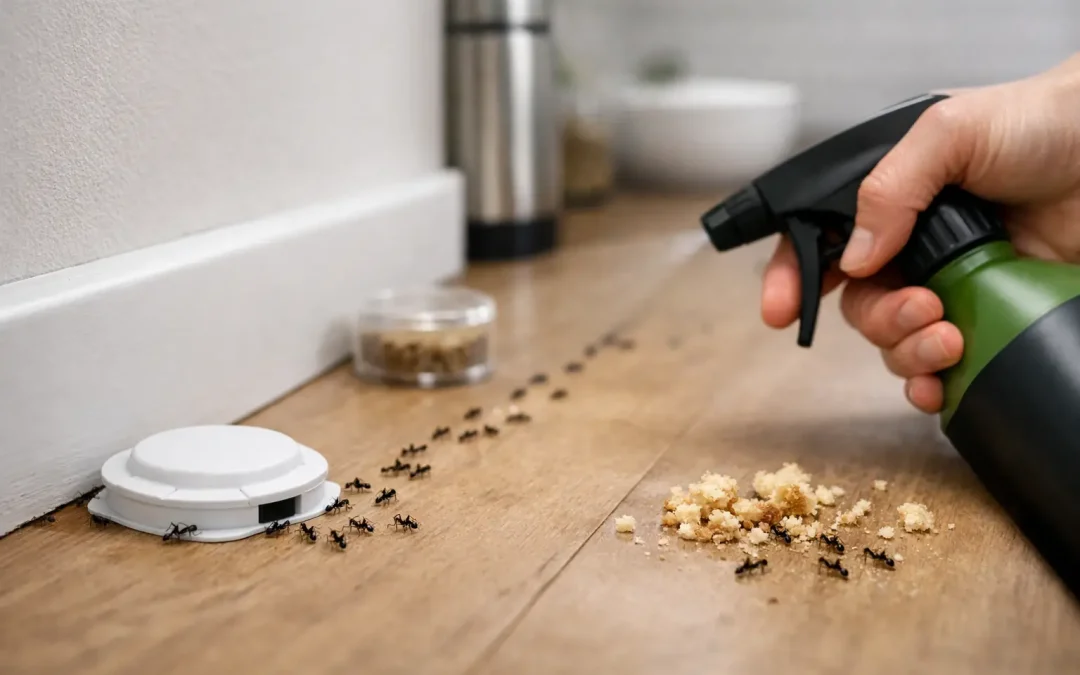
You usually notice ants indoors at the worst possible moment – trailing across a kitchen worktop, clustering around the sink, or appearing in a staff canteen just before opening. Once a trail is established, the problem can escalate quickly. If you are looking for how to stop ants indoors, the right approach is not simply to kill the ants you can see. You need to remove what is attracting them, interrupt their route, and deal with the nest if activity continues.
For homeowners, ants are mainly a hygiene and nuisance issue. For commercial premises, especially in food handling, care, logistics, or regulated settings, they can become a reputational and compliance concern. The good news is that indoor ant problems are often manageable when the cause is identified early.
Why ants are coming inside
Ants rarely enter a building without a reason. In most cases, they are searching for food, water, warmth, or shelter. A small spill behind an appliance, crumbs under a table, pet food left down overnight, or moisture around a sink can all be enough to attract foraging ants.
Once a scout ant finds a reliable source, it leaves a pheromone trail for others to follow. That is why a few ants can become a visible line within hours. It also explains why spraying the trail alone often gives only short-term relief. If the source remains available, more ants may return from the same nest or a nearby satellite nest.
Season also plays a part. Ant activity often increases in warmer months, but indoor sightings can happen at any time if conditions are favourable. In homes and workplaces across Dublin, Kildare, Meath and Wicklow, ant issues commonly start around kitchens, break rooms, bins, utility areas and points where pipework enters the building.
How to stop ants indoors at the source
The most effective way to deal with ants is to make the property less attractive and less accessible. That means looking beyond the insects themselves.
Start with food control. Wipe down worktops thoroughly, clean around skirting boards and under appliances, and store dry goods in sealed containers where possible. Sugary residues are a common trigger, but ants are not limited to sweet foods. Grease, crumbs and pet food can also sustain a trail.
Water matters just as much. Check for leaks under sinks, condensation around pipes, and damp areas near dishwashers or washing machines. Even a small, regular source of moisture can support continued activity.
Then look at access points. Ants can enter through tiny gaps around doors, windows, vents, service penetrations and cracks in masonry. Sealing these entry points helps, but only after you have cleaned the active trail. Otherwise, ants may simply search for the next available route.
Clean the trail properly
One of the most overlooked steps in ant control is removing the scent trail. If you leave it in place, other ants may continue to follow it even after the visible group has gone.
Use warm water and detergent to clean affected surfaces thoroughly. In food preparation areas, use an appropriate hygiene-safe cleaning method suitable for the environment. The aim is to remove the chemical trail, not just the ants themselves. Pay attention to edges, corners, under kickboards and around bin storage areas where trails often continue out of sight.
Vacuuming visible ants can help reduce numbers quickly, but it should not be your only measure. Without proper cleaning and exclusion, the activity often resumes.
Should you use ant spray, powder or bait?
This is where many infestations become prolonged. The wrong treatment can scatter the ants, split the colony response, or give the impression the problem is solved when it is not.
Sprays can kill ants on contact, which may be useful for immediate knockdown. The drawback is that they often do not reach the nest. In some cases, heavy use of repellent products causes ants to avoid one route and appear somewhere else indoors.
Powders can work in some voids and entry areas, but placement is important. In homes with children or pets, and in commercial settings with hygiene obligations, product choice and application need to be handled carefully.
Baits are often more effective for persistent indoor ants because workers carry the treatment back to the nest. That said, baiting only works if the ants are feeding on that bait at the time. If competing food sources remain available, or if the wrong formulation is used, results can be slow or poor.
For a small, isolated issue, a suitable ant bait may resolve the problem. For repeated activity, multiple trails, or infestations affecting a business environment, professional assessment is usually the more reliable route.
How to stop ants indoors without making it worse
There are a few common mistakes that tend to prolong ant problems. The first is treating only what is visible. If you kill the ants on the worktop but ignore the nest, they often return.
The second is overusing shop-bought products. Mixing sprays, powders and cleaning chemicals can interfere with bait uptake and make the ants change behaviour before the colony is controlled.
The third is delaying action when the pattern suggests a larger issue. If ants are appearing in several rooms, reappearing after treatment, or emerging from wall voids, flooring edges or electrical points, the infestation may be more established than it first appears.
In commercial premises, there is another risk. Inappropriate use of pesticides can create safety, audit and documentation problems, particularly in food, care and pharma-linked environments. Control measures need to be effective, but they also need to be suitable for the site.
When ant activity points to a bigger problem
A few ants near a door on a warm day is not the same as regular indoor trails over several weeks. Repeated sightings often indicate one of three things: a nearby nest is well established, there is a hidden food or moisture source, or the building has an access weakness that has not been addressed.
You may also see seasonal swarms of flying ants indoors. This can be alarming, but it does not always mean the nest is inside the property. It can, however, suggest nesting close to foundations, paving, wall cavities or subfloors. If this happens repeatedly, inspection is worthwhile.
For businesses, any recurring ant activity should be treated as more than a nuisance. In customer-facing spaces or hygiene-sensitive operations, even minor sightings can affect confidence and trigger complaints. Early intervention is usually less disruptive than waiting for the issue to become established.
When to call a professional
If your own measures have not worked within a reasonable timeframe, or the ants keep returning, professional pest control is the practical next step. The benefit is not just stronger treatment. It is accurate identification, targeted application, and a plan to prevent recurrence.
A professional inspection should look at species behaviour, nesting risk, attractants, entry points and environmental conditions. In some sites, especially larger homes, blocks of flats, offices, kitchens, warehouses and regulated commercial premises, ant activity can be linked to structural details or operational practices that are easy to miss without experience.
Professional treatment is particularly advisable if:
- ants are present in multiple rooms or units
- activity continues after using over-the-counter products
- the infestation is affecting a kitchen, food area or care setting
- there are children, pets or vulnerable occupants on site
- your business needs documented, compliant pest control action
For clients who need a dependable response, Pest Pure Solutions approaches ant control as part of a wider hygiene and prevention strategy, not a one-off spray-and-go visit. That matters when the goal is lasting control rather than temporary relief.
Preventing ants from coming back
Long-term prevention is usually a combination of housekeeping, maintenance and monitoring. Keep food storage tight, clean up spills promptly, empty bins regularly, and avoid leaving standing water around sinks or plant trays. Inspect seals around doors and windows, and repair cracks or gaps where possible.
In commercial settings, it helps to include ant risk in routine site checks. Staff kitchens, vending areas, washrooms, intake points, waste storage and locker areas can all support pest activity if standards slip. A small recurring issue in one part of a building can spread if not dealt with early.
If ants have been active once, remain alert for reappearance during warmer spells. Quick action at the first sign of a new trail is far easier than dealing with an established infestation.
Ants indoors are rarely random. They are responding to something your property is providing, whether that is food, moisture, shelter or access. When you deal with those conditions as well as the insects themselves, control becomes much more effective. If the problem keeps returning, a proper inspection can save a great deal of time, product waste and frustration.
Recent Comments