
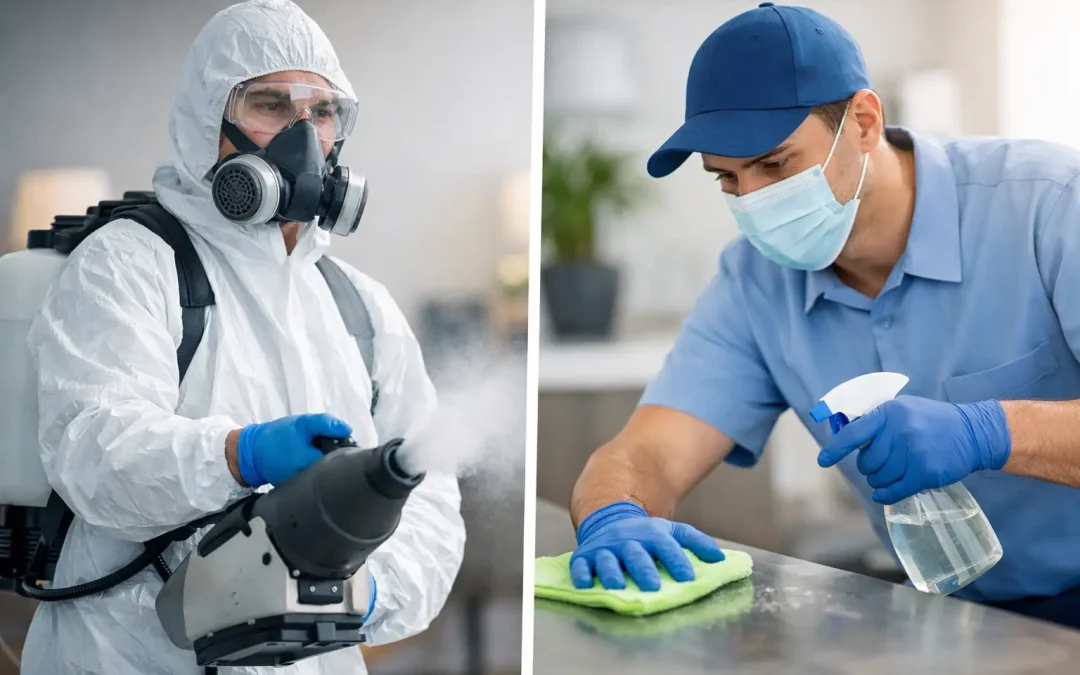
A sick-room clean after a bug outbreak, a food prep area after a contamination concern, and a care setting managing infection risk do not all need the same treatment. That is where disinfection vs sanitisation services becomes more than a wording issue. Choosing the right service affects hygiene standards, safety, compliance, and how quickly a space can return to normal use.
Many people use sanitising and disinfecting as if they mean the same thing. In practice, they serve different purposes. Both reduce risk, but they do so to different levels and in different settings. For homeowners, that can mean avoiding unnecessary cost or making sure vulnerable family members are properly protected. For businesses, it can mean the difference between routine hygiene support and a response that stands up to scrutiny in regulated environments.
What is the difference between sanitising and disinfecting?
Sanitising reduces the number of bacteria and other contaminants on surfaces to a level considered acceptable under public health guidance. It is generally used where the aim is to lower risk rather than eliminate as many harmful microorganisms as possible. In day-to-day terms, sanitisation is often suitable for routine hygiene maintenance in lower-risk environments.
Disinfection goes further. It is designed to destroy or inactivate harmful microorganisms on surfaces, typically through stronger products, more controlled application, and a more targeted treatment plan. It is often chosen after illness, contamination events, confirmed exposure concerns, or where a site has stricter hygiene obligations.
The simplest way to understand it is this: sanitisation lowers contamination, while disinfection is a more intensive control measure. Neither replaces physical cleaning. If dirt, grease, waste, or organic matter is present, the treatment will be less effective. A proper service starts with assessing the condition of the site and deciding what level of intervention is appropriate.
When sanitisation services are the right fit
Sanitisation services are often the sensible choice where there is no known high-risk contamination event, but hygiene still needs to be improved and maintained. This can apply in offices, shared workspaces, reception areas, washrooms, schools, communal residential areas, and homes where occupants want reassurance after illness has passed or after periods of heavy use.
In these cases, the goal is practical risk reduction. Touchpoints such as door handles, desks, handrails, lift buttons, counters, and shared equipment can all carry contamination through normal daily contact. A professional sanitisation treatment helps bring those areas back to a safer baseline.
For commercial premises, sanitisation can also support regular hygiene programmes. It works well when integrated into wider site management that may already include washroom services, pest prevention, waste area hygiene, and routine cleaning schedules. It is not always the highest-level response, but it is often the most proportionate one.
When disinfection services are more appropriate
Disinfection services are usually the better option when there is a clear reason to take stronger action. That might include a confirmed viral or bacterial concern, an outbreak in a care environment, contamination in a food-related setting, bodily fluid incidents, or a need to protect medically vulnerable occupants.
In commercial settings, disinfection may also be needed where records, process controls, and documented hygiene actions matter. Pharma sites, care homes, catering operations, logistics facilities, and waste handling environments often need more than a general assurance clean. They need a treatment that reflects operational risk and, in some cases, supports internal compliance procedures.
For domestic properties, disinfection can be valuable after infectious illness in the home, especially if there are older relatives, babies, or anyone with a weakened immune system. Landlords and property managers may also require disinfection after tenant turnover, severe neglect, or incidents that leave a hygiene risk behind.
Disinfection vs sanitisation services in real settings
The decision becomes clearer when you look at the use case rather than the label.
In a standard office, sanitisation may be enough as part of regular hygiene management, particularly around shared desks, kitchen points, and washrooms. If there has been a known infectious case affecting multiple staff, disinfection is likely to be the more responsible response.
In a family home, sanitisation may suit general reassurance cleaning after visitors, seasonal illness, or moving into a property. If a household member has had a contagious illness or there is concern about exposure on high-contact surfaces, disinfection offers a deeper level of protection.
In a care home or clinical support environment, sanitisation alone may not be enough for outbreak response. Here, disinfection is often the expected standard because the consequences of inadequate treatment are much higher.
In food handling or catering areas, it depends on the issue. Routine hygiene support may involve sanitising protocols, but specific contamination incidents usually require disinfection and a more structured response.
Why professional treatment matters
It is easy to assume that buying a shop product and spraying surfaces gives the same result. In reality, product choice, contact time, application method, and surface type all affect performance. Using the wrong chemical, applying too little, or wiping it away too soon can reduce effectiveness significantly.
A professional service begins with a site assessment. This identifies the risk level, the surfaces involved, occupancy concerns, and whether there are any sensitive materials, food areas, animals, or ventilation considerations. From there, the right treatment can be selected and applied safely.
This is especially important in businesses where hygiene actions need to be defensible. A documented, properly delivered service gives managers a clearer basis for internal reporting and external reassurance. In more tightly governed sectors, that matters just as much as the treatment itself.
What to expect from a proper hygiene service
A reliable provider should not push disinfection when sanitisation is enough, and should not recommend sanitisation when the situation clearly calls for a higher level of control. The right advice should be based on risk, not sales language.
You should expect a clear explanation of what is being treated, why that approach has been chosen, and what preparation or access is needed. In some cases, areas may need to be vacated during treatment or left for a set period before reuse. In others, disruption may be minimal.
For businesses, it is also reasonable to expect service records, treatment details, and practical guidance on keeping standards up afterwards. Hygiene control works best when treatment, cleaning routines, staff awareness, and environmental management all support one another.
The trade-off: stronger is not always better
One of the most common mistakes is assuming disinfection is automatically the best option because it sounds more thorough. Sometimes it is. Sometimes it is excessive for the actual risk, particularly in low-risk spaces where good routine cleaning and periodic sanitisation are entirely suitable.
There can be trade-offs. Disinfection may involve stronger products, more downtime, more preparation, and a higher cost. That can be justified where the stakes are high, but less so where the goal is simply to improve day-to-day hygiene standards.
On the other hand, choosing sanitisation to save time or budget can be a false economy if a site has had a genuine contamination event. If the treatment level does not match the risk, the space may not be properly protected and the issue may quickly return as a concern.
How to choose between disinfection and sanitisation services
Start with the reason for the treatment. Are you managing routine hygiene, responding to a known illness, protecting vulnerable people, or addressing a compliance-sensitive environment? That answer usually points the way.
Then consider occupancy and use. A domestic hallway, a staff canteen, a pharmaceutical area, and a care setting all carry very different exposure profiles. Surface contact levels, traffic volume, and user vulnerability all matter.
Finally, look at evidence and accountability. If the site needs documented action, specialist reporting, or a provider that understands regulated environments, choose a company that can support that properly. In areas such as Dublin, Kildare, Meath, and Wicklow, many clients are not simply buying a spray treatment. They are buying confidence that the hygiene response is proportionate, safe, and professionally managed.
For that reason, experienced providers such as Pest Pure Solutions approach hygiene treatments with the same practical care they bring to pest and washroom services – by assessing the problem properly first, then recommending the treatment that fits.
If you are deciding between the two, the best question is not which service sounds stronger. It is which service matches the risk in front of you, protects the people using the space, and keeps the property operating with confidence.
Recent Comments