
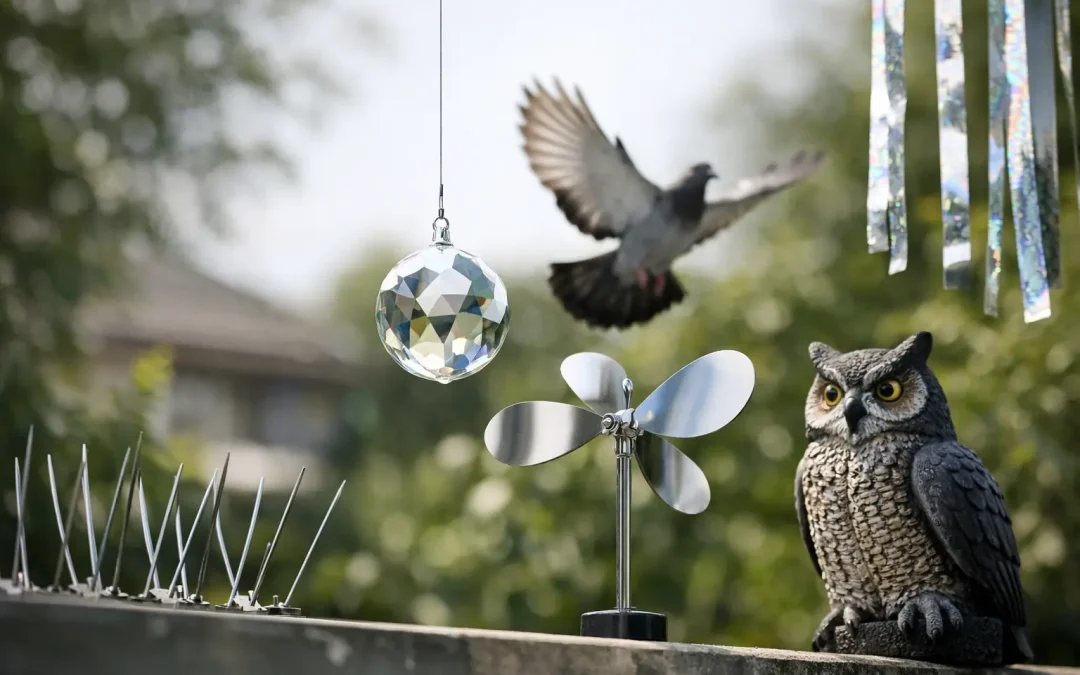
A few pigeons on a roofline can quickly turn into blocked gutters, fouled walkways, damaged signage and a daily hygiene problem. The best ways to deter birds are rarely about one quick fix. They depend on the species, the layout of the property, the food sources nearby and how established the roosting behaviour has become.
For homeowners, bird activity often starts as noise, mess or nesting in awkward places such as eaves, solar panels and balconies. For commercial sites, the stakes are higher. Bird fouling can affect entrances, loading bays, ventilation areas, external plant equipment and customer-facing spaces, with clear hygiene and reputational consequences. In some settings, it can also create compliance concerns.
What makes bird deterrence work
Effective bird control is based on pressure, access restriction and habitat change. If birds can still land comfortably, find food or return to a familiar nesting point, they will keep trying. That is why the best results usually come from combining deterrent measures rather than relying on a single product.
It also matters which bird you are dealing with. Pigeons, gulls and smaller pest birds do not behave in exactly the same way. A method that works well on a domestic roof edge may be far less effective on a warehouse canopy or waste handling area. The aim is not to create unnecessary disruption. It is to make the site unattractive, difficult to access and unsuitable for roosting.
Best ways to deter birds around homes and commercial premises
1. Remove food sources first
This is the least dramatic step, but often the most important. Birds stay where food is dependable. Overflowing bins, open skips, food waste near staff entrances, pet food left outdoors and intentional feeding all make deterrents much less effective.
At domestic properties, even regular bird feeding in one part of the garden can encourage pigeons or gulls to linger near roofs and ledges. On commercial sites, poor waste handling can turn a manageable issue into a persistent one. Before installing any physical deterrent, it is worth checking whether the site is unintentionally feeding the problem.
2. Use bird netting for larger exclusion zones
Where the goal is to stop birds entering or roosting in a defined area, netting is often one of the strongest long-term solutions. It is especially effective for courtyards, loading bays, warehouse canopies, roof voids and service yards where birds have repeated access and shelter.
When fitted properly, netting excludes birds rather than simply startling them. That makes it particularly useful on sites with ongoing pressure. The trade-off is that poor installation looks untidy and can fail quickly. Netting needs to be tensioned, fixed correctly and suited to the structure. On visible elevations, appearance also matters, so the specification should be chosen carefully.
3. Fit bird spikes on ledges, signs and roof edges
Bird spikes remain one of the best ways to deter birds from narrow landing and roosting points. They work by preventing birds from settling comfortably on parapets, beams, signage, pipes and external lighting.
Spikes are practical and low maintenance when they are installed on the correct surfaces. They are not a universal answer, though. If the ledge is too wide, or if nearby sheltered areas remain available, birds may simply move a short distance away. The spacing and coverage have to match the behaviour you are trying to stop.
4. Install post and wire systems on architectural ledges
For buildings where appearance is important, post and wire systems can be a more discreet option than spikes. These systems create an unstable landing zone on ledges and projecting features, which makes roosting much less attractive.
They are commonly used on offices, blocks of flats, retail frontages and heritage-sensitive buildings where bulky deterrents would look intrusive. The benefit is visual subtlety. The limitation is that they need precise fitting and regular inspection to remain effective. On high-pressure sites, they may also need to be combined with other measures.
5. Protect solar panels and roof voids
Solar panels have become a frequent nesting point, particularly for pigeons. The sheltered gap beneath the panels is warm, secure and difficult for property owners to inspect. Once nesting material builds up, noise, fouling and blocked drainage can follow.
Mesh barriers around the panel perimeter are usually the most reliable answer. The same principle applies to roof voids, eaves and service openings where birds gain hidden access. Closing off these spaces is far more effective than trying to scare birds away after they have settled.
6. Use visual and sound deterrents with care
Reflective devices, predator decoys and acoustic deterrents can help in some situations, especially when bird activity is new and not yet established. They may be useful in gardens, short-term crop protection, or selected commercial areas where birds are only starting to test a site.
The problem is habituation. Birds quickly learn when a threat is not real. A plastic owl on a roof may look convincing for a few days, then become irrelevant. Sound systems can also create nuisance for neighbours, staff or customers if used badly. These measures are usually best treated as support tools rather than primary control.
7. Manage nesting and roosting pressure early
The longer birds use a site, the harder they are to move on. Nesting material, droppings and repeated return patterns all reinforce the behaviour. Early intervention is usually simpler, cleaner and more cost-effective than waiting until the infestation is well established.
This is particularly important on commercial premises with multiple access points and plant areas that are not inspected every day. Routine checks of roofs, ducting, canopy structures and external service areas can identify activity before it becomes a wider hygiene issue.
8. Choose professional bird proofing for complex sites
Some bird problems are straightforward. Others involve height, access restrictions, public-facing areas, legal considerations or the need for discreet work around live operations. In those cases, professional bird proofing is usually the safer route.
A proper site survey identifies where birds are landing, feeding, nesting and re-entering. It also helps avoid the common mistake of treating the visible problem while missing the actual harbourage point. On regulated or hygiene-sensitive premises, documented recommendations and scheduled monitoring can be just as important as the installation itself.
The best ways to deter birds depend on the setting
A semi-detached house with pigeons under solar panels needs a different approach from a logistics yard attracting gulls around waste skips. The same applies to restaurants, care environments, flat developments and industrial buildings. Good bird control is site-specific.
For homes, the priority is often peace of mind, cleanliness and preventing damage. Residents want a safe solution that keeps birds away without creating risk for children or pets. For businesses, the focus is broader. Access routes, customer impressions, staff welfare, equipment protection and audit readiness may all be part of the decision.
That is why one-size-fits-all advice can be misleading. If the issue is occasional perching, a small deterrent measure may be enough. If birds are nesting, fouling entrances daily or affecting operations, a more structured plan is usually needed.
Common mistakes that make bird problems worse
The biggest mistake is delay. Many property owners wait until droppings become heavy or nesting is obvious, by which point birds are more firmly established. Another common issue is partial proofing. If one ledge is protected but the adjacent beam or roof opening is left exposed, the birds simply relocate.
DIY products are another mixed area. Some can help in light-pressure situations, but cheap materials often fail outdoors, especially in exposed Irish weather. Adhesives break down, fittings loosen and ineffective devices create false confidence. There is also the question of safety. Working at height or near roof edges is not something to take lightly.
It is also worth remembering that bird management must be handled responsibly. Nesting activity and bird species can affect what action is appropriate and when. A professional assessment helps ensure the solution is effective as well as lawful.
When to call for specialist help
If birds are nesting in the structure, repeatedly returning after DIY measures, fouling customer or staff areas, or creating hygiene risks, specialist support is usually justified. The same applies when activity affects solar panels, signage, roof drainage, ventilation points or high-level access areas.
In Dublin and the surrounding counties, bird pressure can be especially persistent in dense urban settings, food-related businesses, transport-linked sites and properties close to regular waste sources. Where the problem is operational rather than just cosmetic, speed matters.
Pest Pure Solutions approaches bird control as a proofing and prevention issue first, with practical measures tailored to the building and the level of risk. That tends to produce better outcomes than short-term scare tactics.
The right bird deterrent should do more than move the problem from one corner of the property to another. It should reduce mess, protect hygiene and make the space easier to manage day after day.
Recent Comments