
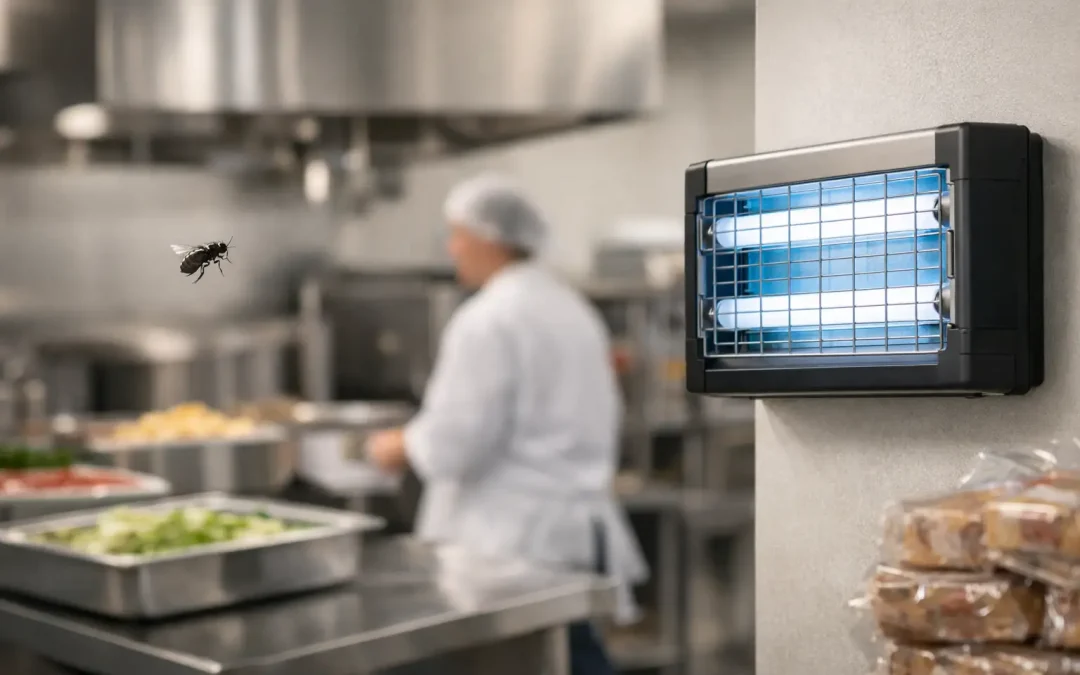
A single fly spotted near a preparation area can quickly become more than a nuisance. For caterers, food manufacturers, warehouses and retail food businesses, flying insect control for food sites protects product integrity, hygiene standards and customer confidence. It also provides the evidence needed to show that risks are being actively managed when an auditor, client or environmental health officer asks to see your controls.
Flies and stored-product moths are attracted to food, moisture, warmth and breeding opportunities. Eliminating the insects visible in the room is rarely enough. Effective control depends on finding why they are present, removing the conditions that support them and monitoring the site closely enough to identify an issue before it affects operations.
Why flying insects are a food safety risk
Flying insects can move between waste areas, drains, external bins, delivery bays and food-handling spaces. Houseflies in particular may carry contamination from one surface to another, while fruit flies and drain flies often indicate damp organic matter or poor sanitation in a localised area. Moths in dry-food storage can damage stock and create costly waste.
The commercial impact varies by site. In a busy restaurant kitchen, an increase in fruit flies around a bar or wash-up area can damage customer perception immediately. In a food production or packing environment, insect activity may result in product checks, rejected stock, increased cleaning demands and investigation during a quality audit. A distribution facility may find insects entering through open loading doors or arriving with goods, then establishing around spills or poorly managed waste.
This is why professional control must be based on risk, rather than relying on a one-off spray or insect light trap alone. The right approach depends on the insect species, the location of activity, the food handled on site and the controls already in place.
Flying insect control for food sites starts with identification
Correct identification is the foundation of a useful treatment plan. Different insects breed in different places, respond to different controls and point to different hygiene or proofing issues.
Small fruit flies are commonly associated with fermenting food residues, sugary spills, recycling areas, bar drains and overripe produce. Drain flies, which have a moth-like appearance, often breed in the organic film that builds up inside damaged or poorly cleaned drains. Houseflies may enter from outside but can also be drawn to waste compactors, food waste, animal by-products or gaps around doors. Indian meal moths and other stored-product pests can originate in infested dry ingredients, packaging or stock held beyond its intended rotation period.
A professional inspection should establish where insects are being caught or seen, when activity occurs, which species are involved and whether there is evidence of breeding. This prevents a common mistake: treating the visible adult insects while leaving the source untouched.
Monitoring devices provide evidence, not just insect catch
Insect light traps, pheromone monitors and sticky monitoring boards can be valuable tools in food premises. They help identify trends, capture specimens for identification and demonstrate that routine monitoring is in place. However, they need correct positioning and regular servicing.
For example, an insect light trap should not be placed where it can attract insects towards exposed food or directly above food preparation surfaces. A trap close to an entry point may reveal incoming activity, while one in a storage area may indicate a local stock issue. Catch data should be reviewed, not simply recorded. A rising count in one area calls for investigation before it becomes a wider infestation.
Remove breeding sites and food sources
Good hygiene is one of the strongest defences against flying insects. This is not limited to visible cleaning. Insects often breed in overlooked areas where food debris and moisture accumulate over time, including floor-wall junctions, undersides of equipment, drain channels, waste bins, recycling containers and spill trays beneath refrigeration units.
Drain management deserves particular attention. Pouring a chemical product into a drain may reduce odours temporarily, but it may not remove the biofilm where drain flies develop. Thorough mechanical cleaning, followed by an appropriate maintenance programme, is usually more effective. Any damaged drain covers, standing water or slow-flowing drainage should be investigated as part of the corrective action.
Waste should be removed at a frequency suitable for the site and stored in clean, closed containers. External bins and compactors need routine cleaning, especially during warmer months. Inside, staff should be able to clean food debris quickly from equipment and report leaks or drain problems without delay. These practical measures reduce the attraction that makes food premises vulnerable in the first place.
Proofing limits insect entry
Not every flying insect problem starts indoors. Open doors, damaged fly screens, gaps around pipework and poorly sealed loading bays can provide easy access, particularly in sites with frequent deliveries or high footfall.
Proofing should focus on the routes insects are actually using. This may involve fitting or repairing mesh screens, improving door seals, managing doors during deliveries or using suitable air movement at entrances where practical. External lighting can also influence insect activity around entrances, so its position and type should be considered where recurring catches are linked to a particular doorway.
There is a balance to strike. Food sites need ventilation, staff access and efficient goods movements. The aim is not to make operations difficult, but to reduce avoidable entry points while maintaining a workable site routine.
Targeted treatment has a place, but it is not the whole solution
Where there is active fly or moth activity, a qualified pest professional may recommend a targeted treatment alongside cleaning, proofing and monitoring. The treatment method must suit the environment and be carefully planned around food safety procedures, production schedules, exposed food and sensitive equipment.
In many cases, physical removal of breeding material, improved sanitation and monitoring will deliver the most sustainable result. Insecticidal treatments can help reduce an established population, but they will not resolve an unclean drain, infested dry stock or an external waste issue on their own. Repeated treatment without source control can create unnecessary disruption and fail to address the underlying risk.
Any treatment should be documented clearly, with advice for site staff on preparation, exclusion periods where required and follow-up actions. For high-governance businesses, this documentation is as important as the treatment itself.
Build control into your food safety routine
Flying insect management works best when it is part of daily site discipline rather than an emergency response. Staff should know what unusual activity looks like, where to report it and why quick reporting matters. A sudden increase in flies near one sink, for example, may reveal a drainage issue early enough to avoid a larger problem.
Regular inspections should assess hygiene conditions, pest activity, proofing defects and monitoring trends. Findings need to be translated into practical actions with clear ownership. If a loading-bay door is routinely left open, the solution may involve operations management as much as pest control. If moths are found in a dry store, stock rotation, supplier checks and disposal procedures may all be relevant.
For sites working to HACCP-based systems, retailer standards or internal quality requirements, pest control records should be organised, current and meaningful. Service reports, trend analysis, site plans, corrective actions and proofing recommendations help demonstrate due diligence. They also give managers a clearer picture of recurring risks across the premises.
When specialist support is needed
A professional service is particularly valuable where insect activity is persistent, species identification is uncertain or the site operates under strict audit and compliance requirements. Care homes, food production facilities, catering operations, logistics centres and waste-handling areas may need a tailored programme with scheduled inspections, device servicing, detailed reporting and rapid response to incidents.
Pest Pure Solutions provides commercial pest management and hygiene support across Dublin and surrounding counties, with programmes designed around the realities of each food site. The priority is to identify the source, reduce risk without unnecessary disruption and provide clear records that support safe, compliant operations.
The most reliable control programme is one your team can maintain every day: clean the places insects use, close the routes they enter through, review the evidence from monitoring and act before a small catch becomes a serious food hygiene concern.
Recent Comments