
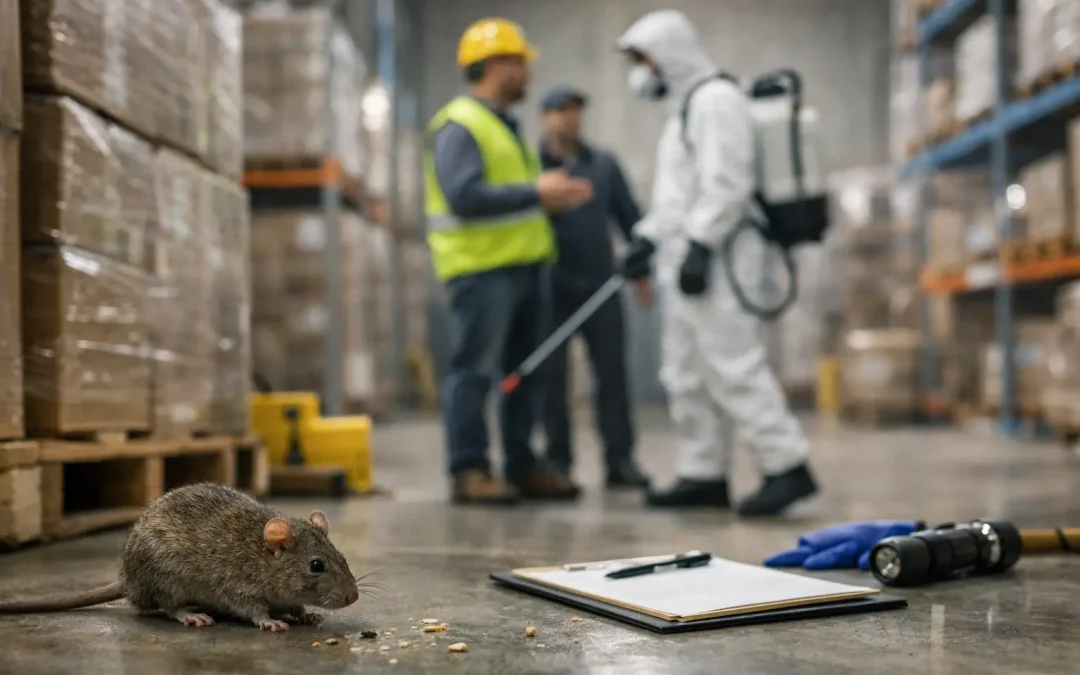
A warehouse pest incident rarely begins with an obvious infestation. It may be a gnawed outer case on a pallet, droppings beneath racking, flies around a goods-in area, or a moth found near stored packaging. Whatever the first sign, the response needs to be calm, controlled and properly documented. In logistics, food handling, pharmaceutical and other regulated environments, a delayed or poorly managed response can put stock, hygiene standards, customer confidence and audit readiness at risk.
The first 24 hours matter because they establish whether a minor finding remains contained or becomes an operational problem. Immediate action should protect people and products while allowing trained pest management professionals to identify the source, species and appropriate treatment.
How to respond to a warehouse pest incident
The correct response depends on the pest, the warehouse layout, the type of goods stored and the standards your business must meet. A single bird entering through an open loading bay is handled differently from evidence of rodents in a high-bay storage area. However, every incident should follow the same core principle: contain the risk first, then investigate and correct the conditions that allowed it.
Secure the affected area and protect stock
Do not move potentially affected stock through the warehouse until it has been assessed. Clearly identify the location, time and nature of the finding, then restrict access to the relevant bay, aisle, picking zone or goods-in area. This reduces the chance of contamination being spread through handling, forklifts or packaging movement.
Where there is visible evidence of contamination, such as rodent droppings, urine, insect activity, damaged packaging or bird fouling, follow your internal quarantine procedure. Segregate the stock and record batch, pallet or location details. The decision to dispose of, clean or release stock should be made under the appropriate quality, hygiene and traceability process, particularly where food, medicines, medical devices or sensitive materials are involved.
Avoid dry sweeping or vacuuming rodent droppings without suitable controls. Disturbing contaminated material can create avoidable hygiene and health risks. A professional cleaning and disinfection plan may be required once the source of the activity has been addressed.
Record what has been found before cleaning
Good evidence supports a faster diagnosis and a stronger audit trail. Photograph the issue where safe to do so, noting the precise location and any nearby features such as dock doors, drains, damaged wall panels, waste areas, racking legs or service penetrations.
Record when the issue was discovered, who reported it, what stock or processes may be affected, and any immediate containment action taken. If your site uses pest management devices, check their identification numbers and note whether the activity is close to a monitoring point. Do not relocate traps, insect monitors or bait stations before inspection unless there is an immediate safety reason.
This information helps establish whether the finding is isolated, seasonal, linked to a delivery, or evidence of a wider access issue. It also demonstrates that the business acted promptly and responsibly.
Escalate to the right people
A warehouse pest incident should not sit only with the person who discovered it. Notify the site manager and the relevant quality, facilities, hygiene or health and safety contact under your escalation procedure. In a regulated business, the quality team may need to assess product impact and determine whether a deviation, non-conformance or customer notification process applies.
Arrange professional pest control support quickly. A trained technician can identify the pest accurately, assess the extent of activity and recommend proportionate treatment. Misidentification creates wasted time. For example, a few warehouse moths may indicate a stored-product pest issue in packaging, ingredients or returns, while small flies can point to drainage, food residue or a nearby waste source.
For commercial sites in Dublin, Kildare, Meath and Wicklow, a responsive service provider should be able to support both the immediate call-out and the documentation required to demonstrate control measures afterwards.
What a professional inspection should establish
The aim is not simply to remove the pest that has been seen. A proper inspection establishes why it was there, how it entered and what conditions are supporting activity. Without that work, repeated treatments can become expensive and disruptive without solving the underlying problem.
For rodents, an inspection may focus on gaps around loading doors, damaged dock seals, roller shutter thresholds, external vegetation, drains, utility penetrations and food or waste sources. Insect investigations can involve inspecting incoming goods, packaging stores, staff canteens, waste handling areas, floor-wall junctions, drains and light management around entrances.
The technician should consider the full site flow. Warehouses are not static spaces: lorries arrive, pallet wrap is removed, returned goods wait for assessment, doors are held open, and stock is moved between temperature zones. Each movement can introduce pests or create a route through the building.
A qualified pest management professional should also assess existing monitoring. Too few devices, poorly positioned monitors or gaps in inspection frequency may leave the site without early warning. Conversely, adding equipment without addressing proofing and housekeeping will not deliver lasting control.
Treatment must fit the warehouse environment
Effective treatment is specific to the pest and the risk level. Rodent control may involve targeted trapping, carefully managed baiting where appropriate, intensified monitoring and proofing recommendations. Flying insect activity may require species identification, insect light trap review, drain treatment, source removal or changes to waste and cleaning routines.
In environments with sensitive stock, treatment selection must account for product protection, employee safety and operational continuity. This can mean scheduling work around picking windows, segregating treatment areas, using non-toxic monitoring where appropriate, and providing clear instructions before and after service.
There are trade-offs. Immediate chemical treatment may appear decisive, but it is not always the best first option in a warehouse. If access points remain open or a contaminated food source remains available, pests may return. Likewise, extensive proofing work is valuable, but it may need to be phased where loading operations cannot stop. The right programme balances urgent control with practical corrective actions.
Preventing the next incident
Most warehouse pest problems are prevented through disciplined site standards rather than one-off treatments. Door management is particularly important. Loading doors should not be left open longer than necessary, and damaged brush strips, dock levellers and seals should be repaired promptly. External doors, vents and service entries need regular inspection because small gaps can be enough for rodents and crawling insects.
Housekeeping also has a direct effect. Cardboard, shrink wrap, damaged pallets and returned goods can create harbourage if allowed to accumulate. Waste should be stored in closed, well-managed containers away from building entrances where possible. Spillages must be dealt with quickly, including small residues beneath racking and around vending, welfare and packing areas.
Incoming goods checks are another useful control, especially for sites receiving materials from multiple suppliers or holding food-related products. Inspecting damaged cases, looking for webbing, insect fragments or gnaw marks, and maintaining a clear quarantine process can stop an issue becoming established inside the warehouse.
Build pest control into compliance, not just emergencies
For high-governance sectors, pest management is part of a wider hygiene and quality system. Auditors will often look beyond whether pest control visits are taking place. They may review site plans, trend data, proofing records, corrective actions, service reports, chemical records and evidence that recurring issues have been closed out.
A tailored commercial contract provides regular inspections, documented monitoring and professional recommendations based on your operational risks. Bio-reports and trend analysis can help management identify recurring pressure points, such as increased rodent activity near a waste compound or seasonal flying insect captures around a particular entrance.
Pest Pure Solutions supports commercial operators with professional pest management, proofing and hygiene-led services designed to protect premises, stock and compliance responsibilities. The strongest results come from a partnership in which site teams report early signs, act on practical recommendations and retain clear records of every action taken.
A pest finding does not have to become a major disruption. Treat it as useful intelligence: contain the area, protect stock, call for expert assessment and use the findings to make the warehouse harder for pests to enter, feed and shelter in next time.
Recent Comments