
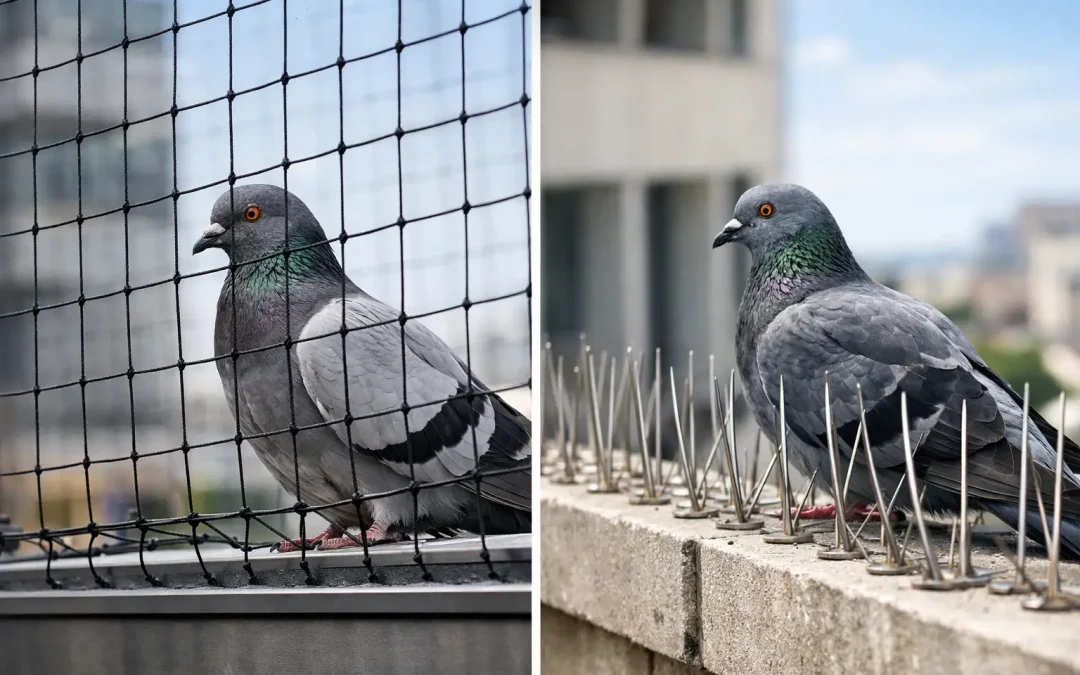
A pigeon roosting above a doorway, loading bay or balcony can quickly become more than an inconvenience. Droppings create slip hazards, damage finishes and contaminate stock or food-contact areas. When considering bird netting vs bird spikes, the best option depends on how birds are using the structure, the level of hygiene risk and whether the area needs complete exclusion or simply a protected landing surface.
For homes, the priority is often preventing mess on ledges, gutters and solar panels. For commercial sites, especially catering, logistics, care and regulated environments, bird activity can affect hygiene standards, staff safety and operational confidence. The right bird-proofing system should be effective, discreet and professionally fitted without causing harm to birds.
Bird Netting vs Bird Spikes: The Core Difference
Bird netting is an exclusion system. It creates a physical barrier that prevents birds from reaching a defined space, such as a canopy, courtyard, plant area, roof void, loading bay or the underside of solar panels. When correctly specified and tensioned, it can protect a large or awkward area for many years.
Bird spikes are a landing deterrent. They are fitted to narrow surfaces where pigeons or gulls regularly perch, including parapets, signs, pipework, window ledges and roof edges. The spikes make the surface unsuitable for landing, encouraging birds to move elsewhere.
Neither system is automatically better. Netting offers the most certain answer where birds must be kept out of an area altogether. Spikes are often the cleaner, less visually intrusive option for exposed ledges and other narrow perching points. A professional survey identifies the species involved, nesting activity, access routes and the pressure placed on the building before a recommendation is made.
When Bird Netting Is the Better Choice
Netting is generally the strongest solution where a bird has an enclosed or semi-enclosed area to occupy. This may include an internal courtyard, warehouse canopy, covered walkway, waste compound, atrium or service yard. In these settings, treating one or two ledges may not solve the underlying problem because birds can still fly into the space, roost on beams and build nests.
It is also highly effective for solar panels. Pigeons commonly nest in the sheltered gap beneath panels, where nesting material and droppings can build up out of sight. Mesh fitted around the panel perimeter blocks entry while allowing appropriate ventilation and access for maintenance.
For businesses, netting can provide valuable certainty. A food premises, pharmaceutical facility or care setting may need to demonstrate that practical controls are in place to prevent bird contamination in sensitive zones. A properly installed exclusion system, supported by inspection records and reporting, is easier to manage than repeatedly cleaning up after active roosting.
However, netting is not a universal answer. It needs secure fixing points, correct mesh size and sufficient tension. Poorly fitted netting can sag, trap debris or create gaps that birds exploit. On a prominent historic façade or small domestic elevation, the appearance and access requirements may make another method more suitable.
What professional netting installation involves
Effective netting is not simply stretched across an opening. The installation begins with cleaning and removal of accumulated nesting material where safe and appropriate. A technician then establishes the perimeter, selects suitable fixings for the building fabric and uses the correct mesh specification for the target species.
The net must be taut, sealed at its edges and installed so birds cannot become entangled. It should also allow safe access where maintenance is required for lights, gutters, vents or building services. This attention to detail is what separates a reliable exclusion measure from a temporary-looking barrier that soon fails.
When Bird Spikes Are the Better Choice
Spikes work well on narrow, linear perching surfaces. A short run of spikes along a window ledge, shop sign or parapet can stop pigeons settling in the place that causes the problem, without enclosing the wider area. They are particularly useful where access is straightforward and the objective is to protect a visible architectural feature.
They can be a cost-effective choice for isolated hotspots. If birds are gathering on one roof edge and not entering a roof void or covered area, full netting would be excessive. Correctly fitted spikes address the specific behaviour with minimal alteration to the property.
The key word is correctly. Spikes must cover the full usable width of the perch, including corners and changes in level. Wide ledges may need more than one row. If gaps are left at either end, pigeons may simply move a few centimetres and continue to roost. They must be securely fixed to a clean, sound surface rather than attached over existing droppings and nesting debris.
Spikes are a deterrent, not an exclusion barrier. Determined birds may continue to occupy nearby areas, particularly where food, shelter or a nesting site remains available. On canopies, open service yards and structures with many beams, spikes alone can become an expensive patchwork with limited long-term value.
Hygiene, Safety and Welfare Considerations
Bird proofing should always begin with safety and welfare. Bird droppings can create slippery surfaces and may carry organisms of concern, particularly where they accumulate in areas used by staff, residents, customers or children. Cleaning should be controlled carefully, with suitable personal protective equipment and safe waste handling rather than dry brushing or disturbing contaminated material unnecessarily.
Active nests, eggs and young birds require particular care. Wildlife protections may apply, and work should be planned around breeding activity where necessary. A responsible contractor assesses the situation before removing materials or installing proofing, rather than treating every nest as routine debris.
Both netting and spikes should prevent access without injuring birds. Damaged netting, loose fixings and poorly positioned spikes can create avoidable welfare risks and undermine the purpose of the installation. Regular inspections are especially worthwhile on commercial sites, where weather exposure, building works and debris can affect performance.
Cost and Maintenance: Looking Beyond the First Visit
Bird spikes often have a lower initial cost on a short, accessible ledge. Netting may cost more because it requires a supporting cable system, specialised access and a larger installation area. That comparison changes when birds are active across a broad structure. Installing spikes repeatedly across dozens of beams, ledges and pipes can be less efficient than excluding the entire space with netting.
Access is a major cost factor for either system. High-level rooflines, busy loading areas and sites that require mobile elevated work platforms need careful planning. Commercial premises may also need work scheduled around deliveries, residents, staff movements or production controls.
Maintenance should be part of the decision. Spikes need checking for leaves, wind-blown debris and damage. Netting should be inspected for tension, tears and gaps around service penetrations. A planned bird-control programme can combine proofing with cleaning, monitoring and documentation, helping facilities managers show that the risk is actively controlled rather than only addressed after complaints arise.
Choosing the Right System for Your Property
Start with the bird behaviour, not the product. If pigeons are landing along a single parapet, spikes may provide a neat and effective solution. If they are flying into a covered yard, nesting beneath solar panels or roosting throughout a canopy, netting is usually the more reliable option.
It is also worth considering why birds are present. Open waste, food spills, overflowing bins and accessible water sources can draw birds back even after proofing has been installed. Good housekeeping, suitable bin management and prompt removal of nesting material can make a significant difference to the lifespan of any bird-control measure.
For complex commercial premises in Dublin, Kildare, Wicklow or Meath, a site-specific survey is particularly valuable. The solution may involve netting in one area, spikes on exposed ledges and hygiene controls around waste handling. Pest Pure Solutions can assess the practical and compliance requirements of the site before recommending a tailored, humane bird-proofing approach.
The most effective bird control is the system that removes the birds’ access to shelter and perching without creating a new maintenance problem. Choose proofing based on the structure, the bird pressure and the hygiene standard your property needs to maintain.
Recent Comments