
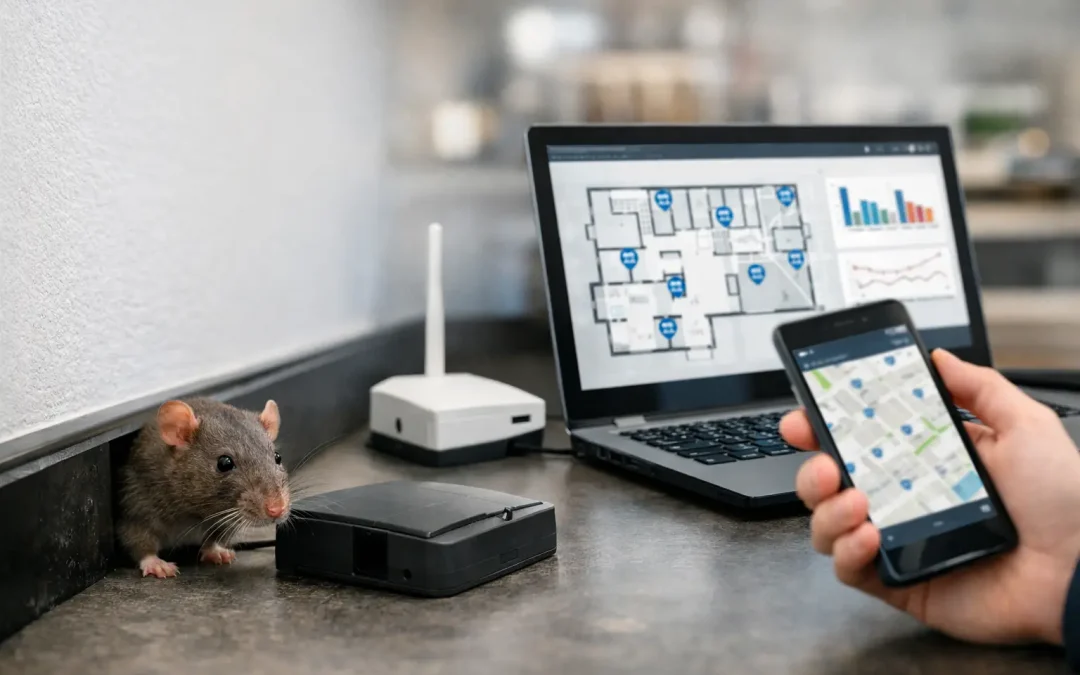
A rodent sighting in a warehouse, care home kitchen or pharmaceutical facility is not simply a pest control issue. It can expose weaknesses in stock protection, building fabric, waste handling and hygiene procedures. Rodent monitoring software gives site teams and pest professionals a clearer way to record activity, identify developing risks and demonstrate that appropriate action has been taken.
For commercial premises, this information matters as much as the treatment itself. A trap checked without a record cannot show a trend. A single sighting recorded accurately, however, may reveal a route of entry, a seasonal pattern or an issue at a neighbouring loading bay before it becomes a wider infestation.
What rodent monitoring software does
Rodent monitoring software brings inspection records, bait and trap locations, activity findings, photographs, recommendations and service reports into one managed system. Depending on the arrangement, it may be used by the pest control provider, the client’s site team, or both.
At its most practical, the software replaces scattered paper reports and informal updates with a live service history. Each monitoring point can be assigned a unique reference, shown on a site plan and checked at scheduled intervals. The technician records evidence such as droppings, gnawing, bait take, captures, damaged proofing or no activity. Corrective actions can then be logged against the same location.
This creates a traceable picture of rodent pressure over time. It is particularly valuable where different people inspect a large site, where several buildings are involved, or where senior management needs a straightforward view of pest risks without relying on verbal updates.
Why monitoring data matters more than a trap count
A trap count alone can be misleading. One captured mouse may indicate a local issue dealt with quickly, while repeated bait consumption in several external stations may point to an established rat population nearby. The right response depends on the pattern, the environment and the risks within the premises.
Good monitoring records help distinguish isolated activity from recurring pressure. They also allow a pest management programme to move beyond reactive treatment. If findings repeatedly occur around a compactor, staff entrance or goods-in area, the priority may be improved waste control, drainage checks, door seals or proofing work rather than simply adding more bait stations.
For regulated sectors, the ability to demonstrate this reasoning is essential. Auditors and quality teams will often want to see more than evidence of visits. They need to understand what was found, what action followed, who was responsible and whether the risk was closed out. Clear digital reporting supports that process.
Better decisions at site level
The most useful systems turn inspection findings into practical decisions. A site manager should be able to review the latest report and see where activity has occurred, whether it is increasing or reducing, and which recommendations remain open.
That can improve communication between facilities, hygiene, maintenance and operations teams. Pest control often identifies conditions that fall outside the technician’s direct remit, such as gaps around pipework, overflowing bins, vegetation against walls or food debris beneath equipment. Software provides a visible record of these issues, helping prevent recommendations from being lost after a service visit.
Rodent monitoring software and remote sensors
Digital reporting software and remote rodent monitoring are related, but they are not the same thing. Reporting software records human inspections and actions. Remote systems use connected devices, such as sensors in traps or monitoring units, to transmit alerts when activity occurs.
Remote monitoring can be highly effective in large, complex or high-risk premises. It can reduce the time between activity and response, particularly in areas that are difficult to access or operate outside normal working hours. In logistics facilities, plant rooms, ceiling voids and external compounds, early notification can help teams intervene before damage or contamination risk grows.
There are trade-offs. Sensors require suitable placement, maintenance, connectivity and a clear response process. An alert is only valuable if someone assesses it promptly and takes proportionate action. Remote devices also do not replace professional inspection. A qualified technician still needs to evaluate the wider environment, identify likely harbourage and entry routes, and verify that controls are working.
For smaller premises with low historic activity, scheduled professional monitoring and well-managed digital records may be the more appropriate option. The best approach is based on the site’s risk profile, not the appeal of the latest technology.
Choosing the right system for your premises
The right platform should support the pest management programme already needed for the building. It should not force a generic approach onto a care home, catering kitchen, pharmaceutical site or residential block with very different operational risks.
When assessing rodent monitoring software, consider whether it provides clear site plans, accurate device references, date-stamped inspection records and photographic evidence. It should allow recommendations to be assigned, tracked and closed, rather than appearing as a repeated note on every report. Reports also need to be easy for relevant staff to understand, while containing enough detail for audits and internal quality reviews.
For multi-site businesses, consistency is especially important. Common reporting standards make it easier to compare trends across locations and identify where additional support is needed. However, central oversight should not obscure local circumstances. A city-centre food premises and a rural distribution depot may face very different rodent pressures.
Data security and access levels also deserve attention. Facilities managers may need access to complete reports, while on-site staff may only require action summaries. Decide in advance who can view data, add comments and close recommendations. This prevents confusion and protects the integrity of the record.
A successful programme still starts with inspection
Technology works best when it supports an integrated pest management programme. Before monitoring points are installed or mapped, a professional survey should establish the likely sources of risk. This includes checking building access points, drainage, waste areas, loading doors, external vegetation, food storage, cleaning standards and signs of rodent activity.
The findings should inform a site-specific plan. Monitoring devices must be placed where they can provide meaningful information, not simply spaced evenly around a building. External stations may be needed near known access routes, while internal monitoring should focus on vulnerable areas such as kitchens, risers, storage rooms and plant spaces.
Every device needs a clear purpose. Some points are there to detect early activity, others to monitor known pressure, and others form part of a targeted treatment. When device records lack this context, reports become difficult to interpret and clients may receive activity data without understanding the risk behind it.
Turning reports into action
A report should trigger action, not become another document filed away at the end of the month. Where rodent evidence is found, the response may include intensified monitoring, targeted control measures, proofing repairs, changes to waste storage, staff guidance or follow-up inspections.
The most effective programmes assign ownership and deadlines. For example, a gap beneath a delivery door may be identified by the pest technician, but it will usually need a facilities or maintenance team to arrange repair. Software can make that recommendation visible, but accountability is what gets it completed.
At Pest Pure Solutions, commercial monitoring programmes are designed around the operational and compliance requirements of each site. Detailed records and bio-reports can support businesses that need clear evidence of pest prevention, corrective action and ongoing control.
What homeowners and landlords should expect
Rodent monitoring software is most commonly associated with commercial contracts, but accurate digital records can also help landlords, managing agents and homeowners with recurring problems. A documented inspection history can show where activity was found, the proofing work recommended and whether treatment is reducing the problem.
For a one-off mouse or rat issue, the priority remains a prompt professional inspection and safe treatment. Technology should not delay that response. Where a property has repeated activity, however, records can help identify whether the cause lies in a shared drain, an external harbourage area, gaps in the structure or an issue with waste management.
The measure of a good monitoring programme
The value of rodent monitoring software is not the number of reports produced. It is the confidence that your premises are being checked intelligently, risks are being acted upon and evidence is available when you need it.
For businesses in Dublin, Kildare, Meath and Wicklow, that means combining accurate monitoring with experienced inspection, effective treatment and practical proofing. A well-managed system gives people responsible for a property the information to act early, protect hygiene standards and keep small signs of rodent activity from becoming a much larger operational problem.
Recent Comments