
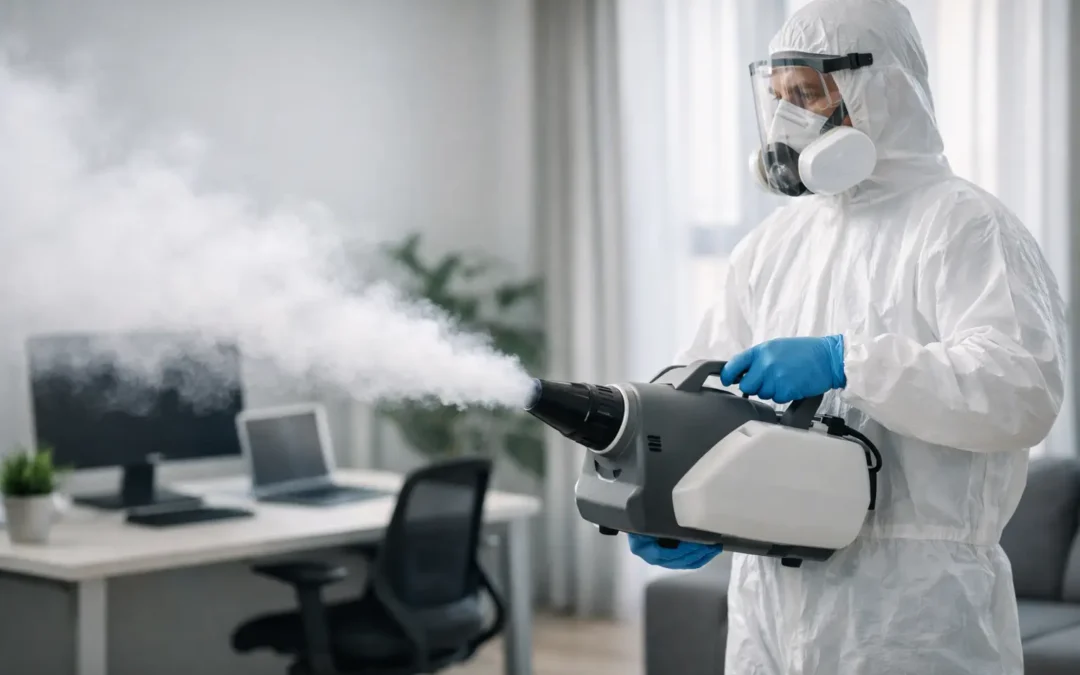
If you are comparing providers, an antiviral fogging services review should start with one simple question – what problem are you actually trying to solve? Fogging can be useful in the right setting, but it is not a catch-all answer for every hygiene concern. For homes, offices, care settings and regulated commercial sites, the value of fogging depends on the product used, the surfaces involved, the level of contamination risk and how the treatment fits into a wider cleaning and infection control plan.
That matters because fogging is often sold as if the machine itself is the solution. It is not. The real measure of quality is the method behind the service: site assessment, chemical selection, application technique, dwell time, safety controls, documentation and follow-up advice. A professional service should explain all of this clearly, not rely on dramatic language or vague promises.
What this antiviral fogging services review looks for
A proper review of antiviral fogging services should focus on outcomes, not appearance. A room filled with mist may look reassuring, but visible fog does not prove effective disinfection. What matters is whether the treatment reaches appropriate touchpoints, uses a suitable disinfectant and is carried out in a way that is safe for occupants, staff, visitors and sensitive equipment.
For commercial clients, especially in sectors such as care, catering, logistics or pharma, there is another layer. The service should support hygiene standards, site procedures and record-keeping requirements. If a provider cannot explain what has been applied, where it has been applied and any limits of the treatment, that is a concern.
For domestic customers, the questions are more practical but no less important. Is the treatment safe around children and pets once the area is ventilated and re-entered correctly? Does it address the spaces people actually touch each day? Is it being recommended for a genuine need, or as an expensive add-on after a pest or hygiene issue?
When antiviral fogging makes sense
Fogging is most useful when you need broad coverage across an area that may have many exposed surfaces, awkward corners or hard-to-reach points. It can be a sensible option after an illness outbreak, after occupancy by a vulnerable person, following a contamination incident, or as part of a hygiene response in shared environments.
In commercial settings, it can also help after confirmed infection concerns, before reopening an affected area, or alongside regular hygiene controls in higher-risk environments. The key phrase here is alongside. Fogging works best as part of a layered process, not as a substitute for manual cleaning, waste control, ventilation and sensible hygiene routines.
There is also a clear distinction between treatment for reassurance and treatment for risk management. A small domestic room with no specific contamination issue may not need specialist fogging at all. A care environment, staff changing area, vehicle fleet, reception space or welfare unit may benefit far more because occupancy levels and transmission risks are different.
Where fogging falls short
This is where many reviews become too generous. Fogging has limits, and a trustworthy provider should say so. If dirt, grease or organic matter is left on surfaces, disinfectants may not work as intended. That means heavily used kitchens, washrooms, bins areas or food handling zones still require proper cleaning before any fogging treatment.
Fogging also does not replace contact-based disinfection of high-touch points such as handles, rails, switches, mobile phones, keyboards and worktops. Those areas often need direct wiping or targeted treatment. If a provider suggests that one fogging visit removes the need for routine hygiene measures, that should be treated with caution.
Another limitation is overpromising on duration. Some companies imply a long-lasting shield remains in place for extended periods. In practice, any treated surface can be re-contaminated through normal use. The service may reduce microbial load at the time of treatment, but it does not freeze an environment in a sanitised state.
What separates a strong provider from a weak one
The best antiviral fogging services are built around assessment and control. Before treatment begins, the provider should ask what type of premises is involved, who uses the space, whether there are vulnerable occupants, what materials and equipment are present, and whether there are any compliance or documentation requirements.
A weaker provider tends to jump straight to price and availability. A stronger one asks practical questions because the site details matter. A school office, a domestic bedroom, a food prep area and a pharmaceutical support room cannot all be treated as if they are the same environment.
Competence also shows in the explanation. A reputable technician should be able to describe whether they are using ULV fogging or another application method, what disinfectant is being used, its intended spectrum, the required contact time and what preparation is needed before arrival. They should also explain ventilation, re-entry times and any precautions for electronics, fabrics or sensitive materials.
For commercial clients, reporting is part of the service quality. If your business needs traceability, audits or internal records, the provider should be able to issue clear service documentation. In regulated sectors, this is not an extra. It is part of responsible delivery.
An antiviral fogging services review for homes and businesses
Homeowners and landlords usually judge a fogging service by peace of mind, speed and safety. Those are reasonable priorities, but the service should still be evidence-led. If a contractor cannot explain why fogging is appropriate in your property, that is not a good sign. In some domestic situations, targeted sanitisation and standard cleaning advice may be more proportionate than a full-area fogging treatment.
Businesses tend to look at the issue differently. They need hygiene protection, but they also need continuity, discretion and documentation. A provider working in a care home, warehouse, catering site or high-governance facility should understand operational pressure. The treatment needs to be effective without creating unnecessary disruption, and the paperwork needs to stand up to scrutiny.
This is one reason specialist hygiene-led operators often perform better than general cleaning contractors offering fogging as a side service. Experience in pest control, disinfection, contamination response and compliance reporting creates a more reliable result because the service is built around risk, not theatre.
Questions worth asking before you book
Before agreeing to any treatment, ask what issue the fogging is meant to address and whether any pre-cleaning is required. Ask what product will be used, what safety data supports it and how long the area must remain vacant. You should also ask whether touchpoint wiping is included or recommended in addition to fogging.
If you are a commercial client, ask what records you will receive afterwards. If your premises are audited, ask whether the provider can support your internal hygiene documentation. If your site includes sensitive operations, ask how they protect equipment, stock and controlled areas during treatment.
It is also worth asking what fogging will not do. That single question often reveals whether you are dealing with a careful professional or a sales-led operator.
The real value of the service
A good fogging service buys you more than a disinfectant application. It gives you a managed response, technical judgement and confidence that the treatment has been carried out properly. That is especially important where reputation, vulnerable occupants or regulatory pressure are involved.
For example, a provider such as Pest Pure Solutions, working across Dublin and surrounding counties, would be expected to approach antiviral treatments as part of a wider hygiene and risk-control service rather than a stand-alone sales item. That is the standard worth looking for – practical advice, safe delivery and documentation that matches the setting.
Price still matters, of course, but cheap fogging is not always good value. If the service is rushed, poorly explained or unsupported by proper assessment, you may end up paying for reassurance rather than results. A more thorough service can be the better investment, particularly in commercial settings where poor hygiene decisions create wider consequences.
The best choice is usually the provider who is prepared to be precise. Not the one who promises the most, but the one who explains the most clearly, works safely and treats fogging as one part of proper infection control. If a service sounds measured rather than dramatic, that is often a very good sign.
Recent Comments