
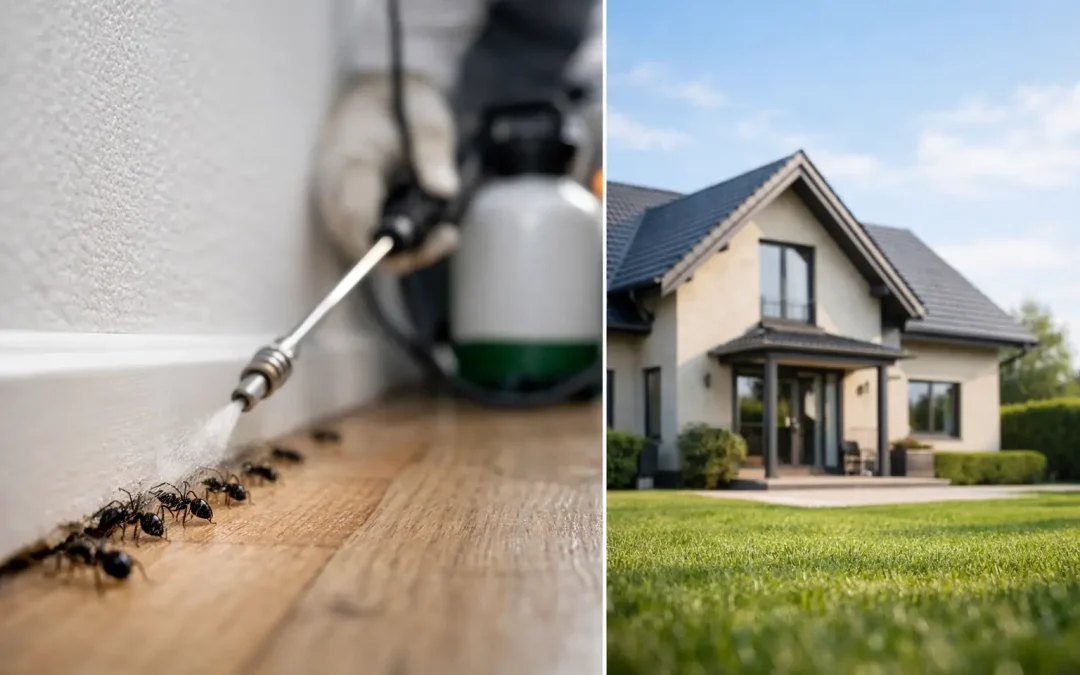
When ants start appearing along a skirting board or around a kitchen worktop, they rarely stay as a minor nuisance for long. Effective ant control Kildare homes can rely on starts with understanding why ants have chosen the property, where the nest is likely to be, and what treatment will stop the activity rather than simply scatter it.
For many households, the pattern is familiar. A few ants appear near the sink, then a steady trail forms from a crack in the wall, a patio door threshold or a gap around pipework. Wiping them away may clear the visible problem for a few hours, but worker ants are guided by scent trails and will usually return unless the source of the infestation is properly dealt with.
Why ants become a problem in homes
Ants are highly organised foragers. Once a food or water source is found, workers lead others back to it quickly. In domestic settings, that usually means kitchens, utility rooms, bin storage areas and sometimes bathrooms. Sugary spills, pet food, crumbs, grease deposits and moisture all make a home more attractive.
In warmer months, activity often increases because colonies are more active and food searching expands. That said, ants are not only a summer issue. Where a nest is established close to a building, or where internal conditions are favourable, householders can notice persistent activity for much longer.
The difficulty is that the ants you can see are only part of the problem. The main nest may be outdoors under paving, in soil beside the property, within cavity walls or beneath floors. In some cases there may be satellite nesting, which makes the infestation harder to resolve with shop-bought products alone.
Signs your home needs professional ant control
A small number of ants by an open window after a warm day is not always a full infestation. Repeated sightings in the same area are different. If ants are consistently appearing indoors, especially in food preparation spaces, it is usually a sign that the colony has established a reliable route into the property.
Typical signs include visible ant trails, clusters around food cupboards, activity near sinks or dishwashers, ants entering through external doors, and sudden increases after attempts to spray them. Winged ants indoors can also indicate a mature colony nearby. While flying ants are seasonal, they should not be ignored if they are emerging from inside the structure or around internal cracks.
For families with children, pets or vulnerable occupants, the hygiene concern often matters as much as the nuisance itself. Ants move between outdoor surfaces, drains, waste areas and food preparation zones. They may not carry the same level of public concern as rodents or cockroaches, but they still present an avoidable hygiene risk.
Ant control for Kildare homes: why DIY often falls short
There is a place for basic housekeeping and early prevention, but DIY treatment has limits. Aerosol sprays may kill the ants you can see, yet they rarely eliminate the queen or destroy the nest. In some cases, poorly targeted spraying causes the colony to split or reroute, which can make the issue seem worse.
Over-the-counter bait products can work where the species is correctly identified, the bait is properly placed and the colony accepts it. The problem is that domestic infestations do not always behave in a textbook way. Competing food sources, nest location, moisture levels and previous treatment attempts all affect results.
This is where professional treatment becomes more reliable. Instead of focusing only on the visible trail, a technician assesses entry points, likely harbourage, nesting conditions and the right treatment method for that specific property. That is particularly important in homes where ants are emerging from wall voids, under floors or through repeated structural gaps.
How professional ant treatment works
The best ant treatment is rarely about one product alone. It is usually a combination of inspection, targeted application and practical proofing advice.
A proper survey identifies where ants are entering, what is sustaining the activity and whether the likely nest is internal, external or both. From there, treatment may involve professional-grade baiting, residual insecticide application in key areas, and direct treatment of external nesting sites where appropriate and safe to do so.
Baits are often effective because worker ants carry the active ingredient back to the colony. That helps address the source rather than just the ants on the surface. Residual treatments may be used around access points and travel routes to reduce activity and break established movement patterns.
The right approach depends on the layout of the home. A ground-floor kitchen with patio access needs a different strategy from a terraced property with ants entering through cavity gaps, or a newer build where service penetrations have not been fully sealed. Good pest control is not guesswork. It is a matter of choosing the treatment that matches the infestation.
The role of proofing and hygiene
Treatment without prevention often leads to repeat call-outs. Even when the active nest is removed, homes remain vulnerable if the original attractants and access points are left untouched.
Simple changes can make a meaningful difference. Food should be stored in sealed containers where practical, crumbs and residues cleared promptly, and pet feeding areas cleaned after use. Overflowing bins, sticky recycling containers and moisture build-up under sinks can all encourage ant activity.
Proofing matters just as much. Gaps around doors, cracked seals, utility entry points and damaged air bricks can provide straightforward access. Not every opening can or should be sealed in the same way, because ventilation and building performance must be considered. That is why practical, property-specific advice is important. The aim is to reduce access without creating other building issues.
What to expect from ant control in occupied homes
Most homeowners want treatment to be effective, discreet and safe for normal household life. That is reasonable. Professional pest control should account for children, pets, food areas and the routine use of the property.
Before treatment, any preparation requirements should be clearly explained. After treatment, you should know what has been applied, where it has been applied, and whether any temporary precautions are needed. In many cases, the process is straightforward, with minimal disruption when instructions are followed properly.
It is also worth being realistic about timescales. Ant activity does not always stop instantly, especially where baiting is used. Short-term continued activity can be part of the process as the treatment is transferred through the colony. What matters is whether the infestation is moving towards elimination rather than simply being disturbed.
Why local conditions can affect ant problems
Homes in Kildare can experience different ant pressures depending on the age of the building, nearby gardens, paving, drainage, and seasonal weather patterns. Properties with warm patios, sandy soil, older pointing, or gaps around extensions can be particularly vulnerable to recurring ingress.
This is one reason local experience matters. A technician familiar with the types of domestic properties and common pest patterns in the area can often identify likely causes faster. That saves time and supports a more precise treatment plan.
For homeowners managing repeat ant problems, especially where previous DIY efforts have failed, a professional service gives clearer control over the issue. Pest Pure Solutions, for example, approaches infestations with the same focus on safe treatment, technical knowledge and practical prevention that households expect from a specialist provider.
When to arrange help
If ants are appearing repeatedly in food areas, moving through wall or floor junctions, or returning after home treatment, it is sensible to act early. Waiting for the problem to grow usually means larger trails, wider spread and more disruption.
The same applies to landlords and property managers. A low-level infestation can quickly become a recurring tenant complaint if the nest source is not removed. Prompt treatment protects hygiene standards and prevents a small issue from becoming a more entrenched one.
A good pest control response should do more than remove visible insects. It should explain why the infestation developed, treat it in a targeted way, and reduce the chance of the same problem returning a few weeks later.
Ants are small, but the frustration they cause in a home is not. The sooner the source is identified and treated properly, the sooner the property returns to normal and stays that way.
Recent Comments