
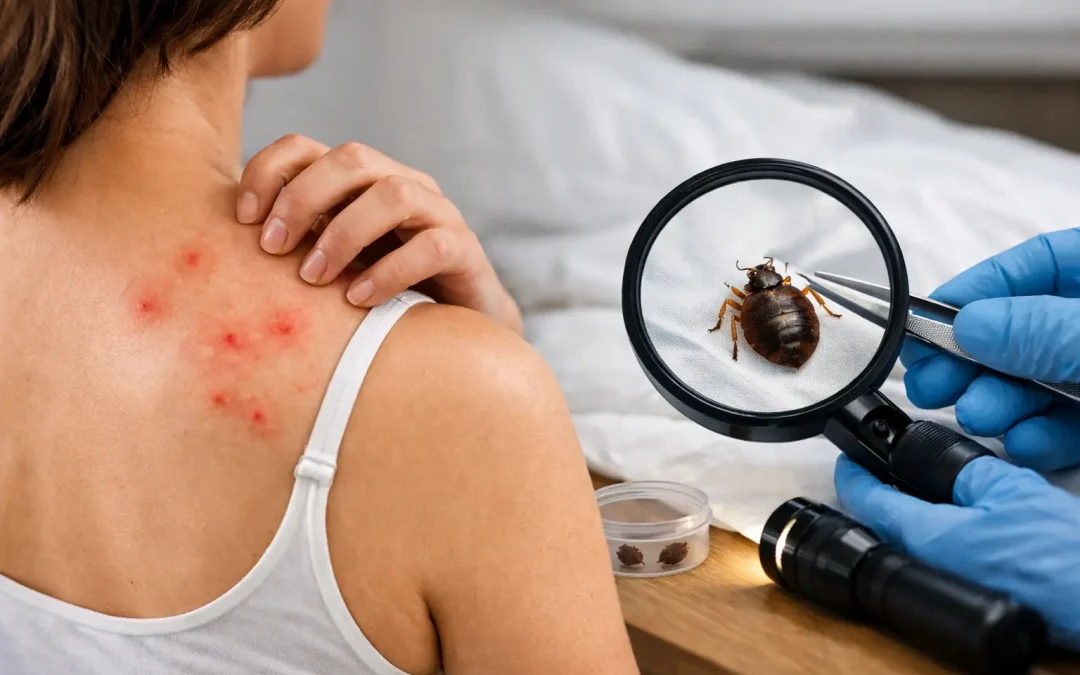
Waking with itchy marks after a night in bed is unsettling, particularly when more appear over the following days. Knowing how to identify bed bug bites can help you respond quickly, but bites alone are not proof of an infestation. Mosquitoes, fleas, eczema and contact reactions can all look similar. The most reliable answer comes from assessing the skin marks alongside physical evidence around the bed or sleeping area.
What bed bug bites usually look and feel like
Bed bug bites are small, raised, red or pink bumps that may have a darker red point in the centre. They are commonly itchy, although some people have little or no reaction at all. The degree of swelling varies widely. One person in a household may have obvious welts while another sleeping in the same room has no visible marks.
Bites often appear on exposed skin, including the arms, hands, shoulders, neck, face and lower legs. This is because bed bugs usually feed while a person is asleep and are drawn to areas they can reach without travelling beneath tight clothing or bedding.
A useful pattern to look for is multiple bites close together. They may form a rough line, a zig-zag, or a small cluster. This is sometimes described as a “breakfast, lunch and dinner” pattern, but it is not present in every case and should not be treated as a diagnosis on its own.
The timing can also be misleading. Some people react within hours, while others do not show marks for several days. If bites are still appearing, it does not necessarily mean the infestation started that night. Bed bugs may have been present for some time before a reaction is noticed.
Key features that raise suspicion
Bed bug bites become more likely when the marks are itchy, occur after sleeping or resting in one particular place, and recur over several nights. A recent stay in a hotel, a visitor staying overnight, second-hand furniture, or luggage brought back from travel can also be relevant. Bed bugs are excellent hitchhikers and their presence is not a reflection of cleanliness.
However, skin appearance is not enough to confirm the cause. The strongest indication is a combination of suspicious bites and signs of bed bugs in the room.
How to identify bed bug bites by ruling out lookalikes
Flea bites tend to be concentrated around the ankles and lower legs, especially where pets are present. They can be intensely itchy and often have a central puncture point. Unlike bed bugs, fleas are more likely to bite during the day as well as at night.
Mosquito bites are often more random and isolated, although several can occur at once. They are more common in warmer months or where windows are open, and may be linked to time spent outdoors rather than a particular bed or room.
Midges and other biting insects can cause similar marks, particularly after being outside in the evening. In contrast, contact dermatitis usually develops where skin has touched an irritant such as a new detergent, fabric conditioner, cosmetic product or cleaning chemical. The rash may be broader and more diffuse than individual insect bites.
Scabies can cause significant itching, often worse at night, but it is caused by mites that burrow into the skin. Fine tracks or lines may be visible, particularly between fingers, on wrists, around the waist or in skin folds. It requires medical assessment and treatment rather than pest control of the property.
If there is swelling around the eyes or mouth, difficulty breathing, widespread hives, signs of infection, or a severe reaction, seek urgent medical advice. Persistent or worsening skin symptoms should also be assessed by a pharmacist, GP or other qualified healthcare professional.
Check the room for evidence, not just bites
Bed bugs are small, flat insects, generally reddish-brown in colour and about the size of an apple seed when fully grown. Young bed bugs are much smaller and paler, while eggs are tiny, white and difficult to see. They hide close to where people rest, rather than living only in the mattress itself.
Start with a careful inspection of the mattress seams, piping, labels and handles. Look around the bed frame, headboard, divan base, screw holes and joints. Use a torch and check nearby furniture, skirting boards, curtain folds, upholstered chairs, bedside cabinets and cracks in the wall or floor.
Physical signs may include:
- Small black or dark brown spotting, often found along seams, joints or crevices. These may be bed bug droppings.
- Pale shed skins, as immature bed bugs grow and moult.
- Tiny white eggs or eggshells in protected gaps.
- Live bed bugs, dead insects or small reddish-brown smears on bedding.
Blood spots on sheets can occur when a recently fed bed bug is accidentally crushed. They are a possible clue, but they can also have other causes. Equally, a lack of visible insects does not rule bed bugs out. They are skilled at hiding, and early infestations can be difficult to locate without experience.
Inspect carefully in commercial settings
For hotels, care environments, rental properties, staff accommodation and other shared premises, a report of bites should be handled promptly and discreetly. Do not assume the source is one room or one guest. Record when and where the concern was raised, inspect the affected room and adjoining areas, and consider recent occupancy, deliveries, furniture movements and luggage traffic.
A professional inspection provides a more dependable basis for decisions that affect hygiene, resident wellbeing, business continuity and reputation. In regulated environments, clear documentation and an appropriate treatment plan are especially valuable.
What to do if you suspect bed bugs
Avoid moving bedding, mattresses or furniture into another room. This can spread bed bugs through the property and make treatment more complicated. There is also no benefit in sleeping elsewhere if it means taking belongings to a new room. Bed bugs may follow and establish themselves there.
Keep any suspected insect, skin, egg or other evidence in a sealed container if possible. Take clear photographs of marks on the skin and signs found around the bed, noting the date and room. This information can support a professional assessment, although photographs of bites cannot confirm the pest by themselves.
Wash affected bedding, sleepwear and washable fabrics at the highest temperature permitted by their care labels, then dry thoroughly using heat where suitable. Items should be placed into sealed bags before being moved through the home. Vacuuming around the bed frame and room edges can help reduce visible activity, but it is not a complete treatment and the vacuum contents should be sealed and disposed of outside promptly.
Do not rely on supermarket sprays, foggers or improvised chemical treatments. Bed bugs can hide deep within cracks, may be resistant to some products, and poorly applied insecticides can drive them into new areas. Treatments must be selected and applied safely, particularly in homes with children, pets or vulnerable occupants.
Why early professional treatment matters
A small number of bed bugs can become a larger infestation quickly because they breed in hidden spaces and feed without being noticed. They can spread through bedrooms, living areas, neighbouring flats, staff lockers, vehicles and communal spaces. The longer activity continues, the more extensive the inspection and treatment process may need to be.
Professional bed bug control starts with identifying the extent of the problem, not simply spraying the obvious bed. A proper approach considers harbourage points, adjoining rooms, furniture, treatment follow-ups and preparation requirements. It may involve targeted insecticide application, heat-based methods or a combined approach, depending on the site and level of activity.
For homeowners, this provides reassurance that the issue is being dealt with thoroughly. For landlords and commercial operators, it helps protect occupants and supports a controlled, documented response. Pest Pure Solutions provides discreet bed bug inspections and treatment programmes across Dublin and surrounding counties, with practical guidance tailored to the property.
Do not let uncertainty lead to unnecessary disruption or delayed action. If recurring bite marks are accompanied by signs near a bed, arrange a professional inspection early – a clear diagnosis is the first step towards restoring a comfortable, hygienic space.
Recent Comments