
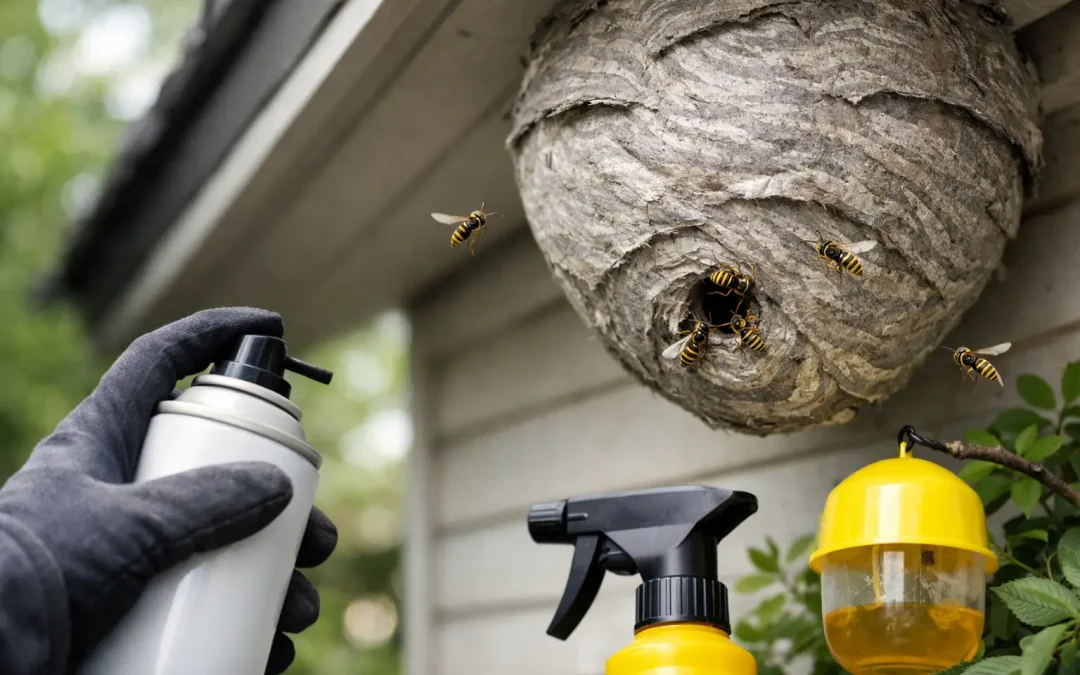
A wasp nest can grow from a small papery structure to a busy colony in a matter of weeks. By late summer, a nest near a door, loft, shed, roofline or commercial entrance can make normal use of the property difficult. The best wasp nest treatment options depend on the nest location, the activity level, the species involved and, above all, the risk to people nearby.
For a nest that is actively used, particularly where children, pets, customers, residents or staff may be exposed, professional treatment is normally the safest and most reliable route. Attempting to remove or block a live nest can provoke defensive wasps and turn a contained problem into an urgent one.
When a Wasp Nest Needs Treatment
Not every sighting of a wasp means there is a nest on your property. A few wasps around bins, flowering plants or outdoor food may simply be foraging. A nest is more likely when you see a steady flight path, with wasps repeatedly entering and leaving the same gap in a wall, soffit, air brick, roof void, shed or ground opening.
Treatment is advisable when the nest is close to frequently used areas or is within the building fabric. It also makes sense where someone at the property has a known severe sting allergy, or where a business has hygiene, safety or customer-care obligations. Care homes, food premises, schools, warehouses and managed residential buildings should act early, as a wasp incident can affect both safety and operations.
A nest positioned high in a mature tree at the far end of a large garden may sometimes be left undisturbed until natural activity stops in autumn. This is not a suitable approach if wasps are entering the building, gathering around an entrance or affecting daily activity. The practical question is not simply whether the nest exists, but whether it creates an unacceptable risk.
Best Wasp Nest Treatment Options Compared
Professional insecticide application
Professional insecticide treatment is the preferred option for most active nests. A trained technician identifies the nest entrance, assesses access and applies a suitable insecticidal dust, powder or liquid directly to the entry point or nest area. Wasps carry the active treatment into the colony, which allows it to reach the queen and workers rather than only affecting the insects visible outside.
This approach is effective for nests in roof spaces, cavity walls, eaves, sheds and underground voids. It is also less disruptive than trying to physically remove a nest while it is occupied. Activity usually reduces significantly after treatment, although some movement around the entrance can continue for a short period while foraging wasps return.
The exact treatment method depends on the location. A nest in a wall cavity needs a different application technique from one under a roof tile or inside a garden outbuilding. This is why a proper inspection matters. The wrong product, applied to the wrong place, can leave the colony active and drive wasps into internal rooms.
Targeted treatment for difficult-access nests
Some nests are not safely reachable from ground level. They may sit behind fascia boards, beneath roof coverings, inside chimney structures or high in commercial cladding. In these cases, professional treatment may require specialist access planning, appropriate equipment and careful consideration of the property structure.
For commercial premises, the treatment plan should also account for staff movement, delivery schedules, public access and sensitive areas such as food preparation rooms. A discreet, controlled response helps protect hygiene standards without creating unnecessary disruption.
Physical nest removal may be considered after the colony has been treated and activity has ceased. It is not always necessary. Once a treated nest is inactive, it will not be reused by wasps the following year. However, removal can be sensible where the nest is accessible, unsightly or likely to obstruct repair work.
Do-it-yourself wasp sprays and powders
Retail wasp sprays and powders can appear to be a quick, low-cost solution, but they have clear limitations. They may be appropriate only for a very small, visible nest in an easily accessible outdoor location, where there is no immediate risk to anyone else. Even then, users should follow the product label precisely and avoid treating the nest when wasps are most active.
DIY treatment is not recommended for nests in lofts, cavities, roofs, under decking, inside wall voids or close to doors and windows. It is also unsuitable for anyone with an allergy risk, limited mobility, poor access equipment or uncertainty about where the nest is located. Spraying the outside of a concealed nest often kills a few worker wasps but does not treat the colony effectively.
Never use fire, boiling water, petrol, expanding foam or improvised methods. These can cause injury, fire damage, contamination or structural problems, while still failing to resolve the infestation. Sealing an active entry hole is also a poor solution. The wasps may find another route into the property, including through internal vents or ceiling spaces.
Waiting until the end of the season
Wasp colonies generally decline in autumn, and the old nest is not normally reused the following year. Waiting can therefore be a reasonable choice for an isolated nest that poses no practical risk. It is not a treatment option for a nest causing distress, restricting access or operating within a workplace.
Timing matters because nests are often at their largest and most defensive from late summer into early autumn. A small nest found early in the season is generally easier to manage than a mature colony with heavy activity. Delaying action simply because the weather may soon change can expose occupants to unnecessary stings.
Why Professional Assessment Is Safer
A professional visit is about more than applying an insecticide. The technician should establish whether the insects are wasps, bees or another flying insect, locate the active entrance and assess whether the nest is likely to be in a void. Honey bees require a different approach and should not be treated as a standard wasp infestation.
A suitable treatment also considers pets, children, ventilation points, water sources and neighbouring properties. In commercial settings, the assessment should include hygiene controls, safe working arrangements and documentation where required. For regulated sites, treatment records can support internal audits and demonstrate that the issue has been managed responsibly.
Pest Pure Solutions provides professional wasp control for homes and businesses across Dublin and surrounding counties, with treatment selected for the nest location and the needs of the property. This is particularly valuable when nests affect high-risk or operationally sensitive environments.
What to Do Before and After Treatment
Keep people and pets away from the nest area before treatment. Avoid mowing, pruning, drilling or carrying out roof work nearby, as vibration and disturbance can trigger defensive behaviour. If wasps are entering through a gap in the building, do not seal it until the treatment has taken effect and the technician confirms it is safe to do so.
After treatment, allow time for returning foragers to contact the treated area. You may still see individual wasps near the entrance during this period. Do not poke, cover or remove the nest prematurely. If heavy activity continues beyond the expected treatment window, contact the pest controller so the nest can be reassessed.
Where the nest was linked to a structural gap, arrange proofing after the colony is inactive. Repairing damaged soffits, fitting suitable vent covers and closing unnecessary openings can reduce the chance of future nesting. Proofing must be planned carefully so that essential ventilation is not compromised.
Reducing the Chance of Future Nests
Wasps favour sheltered, undisturbed spaces. Regularly checking sheds, loft areas, eaves, garages and outbuildings in spring can help identify early nest-building activity. Maintaining rooflines and external cladding is particularly worthwhile for landlords, facilities managers and property owners responsible for larger sites.
Outdoor food waste and overflowing bins can attract foraging wasps, even if they are not nesting nearby. Keep waste contained, clean spillages promptly and make sure bin areas are included in routine hygiene checks. These measures will not remove an established nest, but they can reduce wasp activity around entrances and seating areas.
If a nest is affecting how safely you use your home or workplace, the right response is not to take chances with a ladder and an aerosol. Arrange a professional assessment, keep the area calm and undisturbed, and let the treatment be matched to the risk.
Recent Comments