
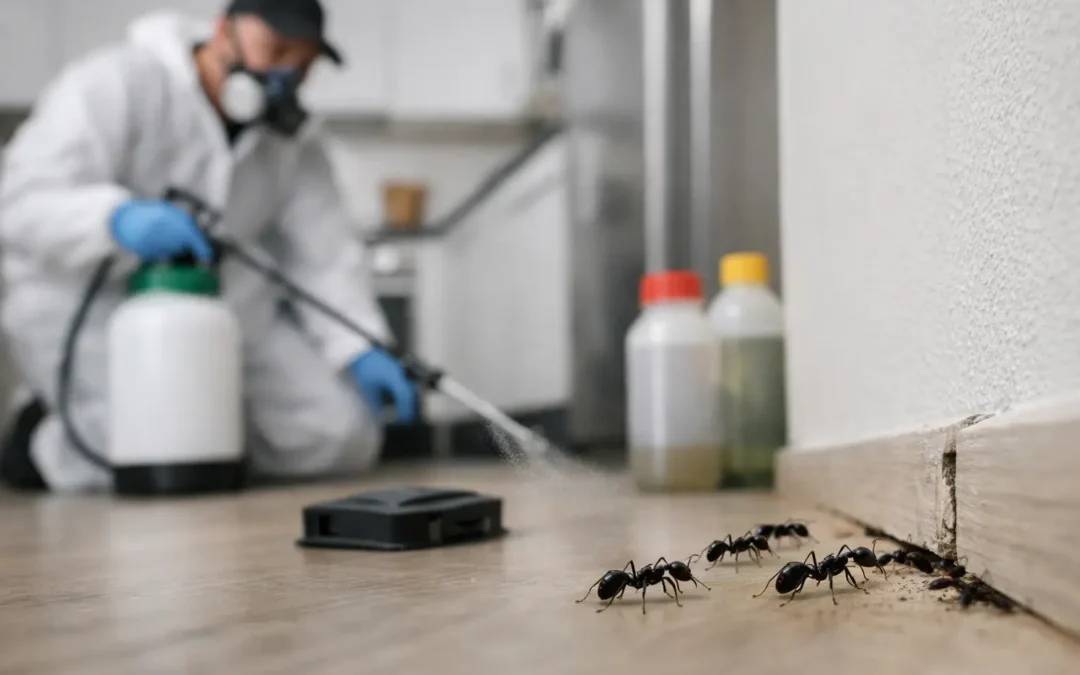
Ants usually become a serious problem just as people try to ignore them. It starts with a few workers near a skirting board, around a sink, or crossing a patio door threshold, and within days the trail is established. When people search for ant infestation treatments Dublin homeowners and businesses can rely on, they are often already past the point where a spray from the supermarket will solve it.
The difficulty with ants is not simply the insects you can see. The visible trail is usually only a small part of the colony’s activity. If the nest remains active under paving, in wall cavities, beneath floors, or close to foundations, the problem tends to return. Effective treatment depends on locating the source, understanding the species involved, and choosing a method that removes the colony rather than scattering it.
When an ant problem needs professional treatment
A small number of ants indoors in warm weather does not always mean a major infestation. Sometimes foraging ants enter through tiny gaps in search of food or moisture and can be managed with sanitation and proofing alone. The situation changes when activity becomes regular, multiple rooms are affected, or ants reappear after repeated cleaning.
For homeowners, the tipping point is often persistence. If ants are appearing in kitchens, utility rooms, bathrooms, or around door frames every day, there is likely to be an established nest nearby. In flats, terraced houses, and shared buildings, the source may even sit beyond the immediate unit, which is one reason self-treatment often gives only short-term relief.
For commercial premises, the threshold is lower. In catering areas, care environments, logistics facilities, waste handling sites, or any hygiene-sensitive setting, ant activity is more than a nuisance. It can undermine cleanliness standards, create audit issues, and damage confidence among staff, residents, customers, or inspectors. In those settings, quick and documented action matters.
What causes ant infestations in Dublin properties
Most ant issues come down to access, food, moisture, and shelter. Ants are highly efficient at exploiting small structural weaknesses. Cracks around window frames, movement joints, service entry points, damaged seals, and gaps beneath doors all create opportunities.
Seasonal conditions also play a part. Warmer periods increase foraging activity, and rain can push ants away from disturbed outdoor nesting sites towards drier indoor areas. Properties with patios, older brickwork, garden borders against walls, or poorly sealed kitchen areas are particularly vulnerable.
In commercial environments, the risk often rises where food residues, packaging waste, staff kitchen areas, and frequent door openings combine. Even well-managed sites can be affected if external harbourage is not addressed. That is why treatment is rarely just about applying product. It also involves reducing the conditions that let the colony thrive.
Ant infestation treatments Dublin homes and businesses use
The right treatment depends on the scale of the infestation, nest location, property type, and sensitivity of the environment. There is no single universal fix.
Baiting is often one of the most effective options because it targets the colony through worker behaviour. Ants carry the bait back to the nest, where it can affect a wider population, including queens. This approach is usually more effective than surface spraying alone, particularly where the nest cannot be directly accessed. It also helps avoid the common problem of splitting the colony’s movement without solving the cause.
Residual insecticidal treatments can also be appropriate, especially around entry points, foraging routes, and external areas where nesting is suspected. These treatments need to be applied carefully and in the right places. Overuse or poor placement can reduce effectiveness and may simply cause ants to redirect their route.
Dust formulations may be used in voids, cracks, and nesting sites where liquid application is unsuitable. In some cases, direct nest treatment outdoors is the quickest route to control, especially when nests are visible in paving, soil edges, or beside building foundations.
Professional ant infestation treatments Dublin property managers choose for regulated settings tend to be more controlled and documented. Treatment has to fit the site’s operational needs, hygiene requirements, and reporting standards. In food handling or care environments, that means using appropriate methods, clear site records, and practical recommendations to reduce repeat activity.
Why DIY ant control often falls short
Shop-bought ant killers can be useful for very minor problems, but they often fail when a colony is already established. Many people treat only the visible trail, which may kill some workers without affecting the nest. The result is familiar – activity drops briefly, then returns from a different angle.
There is also a risk in using the wrong product in the wrong way. Strong repellent sprays can disrupt ant movement and push activity deeper into wall voids or adjoining rooms. Indoors, repeated chemical use around food preparation areas, children, or pets needs careful judgement. What seems like decisive action can make the infestation harder to track and harder to eliminate properly.
A professional approach starts with inspection rather than assumption. That matters because not all ant problems behave the same way. Nesting outside with occasional ingress is a different issue from repeated internal activity linked to hidden voids or structural defects.
The inspection process matters as much as the treatment
Good ant control begins by confirming where ants are travelling, what is attracting them, and where the colony is likely to be based. That may involve inspecting kitchens, skirtings, external walls, paving joints, bins, drains, service entries, and moisture-prone areas.
In domestic properties, the aim is straightforward – remove the active infestation with as little disruption as possible and reduce the chance of recurrence. In commercial properties, the process is broader. Inspection may need to account for site layout, staff movement, loading areas, waste storage, hygiene zones, and any compliance obligations attached to the business.
This is where an experienced contractor adds real value. The treatment itself is only part of the service. Practical advice on proofing, cleaning focus areas, waste handling, and maintenance can make the difference between a one-off response and lasting control.
What to expect after treatment
Ant activity does not always stop instantly, and that can worry property owners who expect all movement to disappear on day one. With bait-based treatments, continued movement for a short period may actually be part of the process, as workers carry material back to the nest.
The expected timeline depends on colony size, species, weather, and nest position. Outdoor nests under slabs or close to foundations may take longer to resolve than a small, localised issue around one entry point. Where there are multiple nests or strong environmental attractants, follow-up treatment may be needed.
That is not a sign of failure. It is a sign that the problem is being managed properly rather than masked. Reliable pest control includes monitoring results and adjusting the treatment plan where necessary.
Preventing ants from coming back
Prevention is rarely glamorous, but it saves time, cost, and repeat disruption. The most useful steps are usually basic ones done consistently. Food spillages should be removed promptly, dry goods stored properly, bins sealed, and moisture issues such as leaks or condensation addressed.
Entry points also matter. Sealing cracks, replacing worn door sweeps, repairing damaged seals, and reducing vegetation or debris against external walls can all help. Outdoors, disturbed paving and nest-friendly gaps near the building should not be ignored if ant activity has already been identified.
For businesses, prevention needs to be more structured. Regular inspections, documented actions, and site-specific recommendations are especially valuable in sectors where hygiene and audit readiness are non-negotiable. A treatment visit without preventive follow-through can leave unnecessary risk on the table.
Choosing a provider for ant infestation treatments Dublin wide
Speed matters when ants are active, but so does competence. A dependable provider should be able to assess domestic and commercial risk properly, explain the treatment approach clearly, and recommend sensible next steps rather than offering a generic spray-and-go service.
For homeowners, that means clear advice, safe application, and treatment that deals with the root of the infestation. For commercial clients, it also means discretion, reporting, and an understanding of operational pressures. In regulated sectors especially, pest control has to support hygiene management and business continuity, not interrupt them.
Pest Pure Solutions works with both residential and commercial clients, which is important because ant problems do not look the same in a family kitchen as they do in a care setting, a catering site, or a logistics operation. The treatment should fit the environment.
If ants are appearing repeatedly, the practical step is not to wait for the trail to get worse. Early treatment is usually simpler, cleaner, and more cost-effective than dealing with a well-established infestation spread across multiple access points. A prompt inspection now often prevents a much larger problem when the weather turns warmer again.
Recent Comments